Introduction
ESG reporting platforms are specialized software tools designed to help organizations collect, manage, and share data related to their environmental, social, and governance performance. These tools serve as a central hub where a company can track its carbon footprint, monitor labor practices, and ensure board transparency. Instead of relying on scattered spreadsheets that are prone to errors, these platforms provide a structured way to turn raw data into professional reports that meet global standards.
The importance of these platforms has grown significantly as investors, customers, and government bodies now look closely at how a company impacts the world. Beyond just checking a box for compliance, using a platform allows a business to identify where they are wasting energy, how they can improve their supply chain, and where they might face risks in the future. Real-world use cases include a manufacturer tracking the emissions of its global suppliers, a retail chain reporting on its diversity and inclusion metrics, or a financial firm ensuring its investments align with ethical standards.
When choosing a tool, you should look for ease of data collection, the ability to support multiple reporting frameworks, and how well the software can handle audits. It is also vital to check if the tool can grow with your company and if it offers strong security to protect your sensitive business information.
Best for: Large corporations with complex supply chains, public companies needing audit-ready disclosures, and sustainability teams in industries like manufacturing, finance, and energy.
Not ideal for: Very small businesses with minimal reporting needs or organizations that only want to track basic energy bills, where a simple spreadsheet or basic accounting software might be enough.
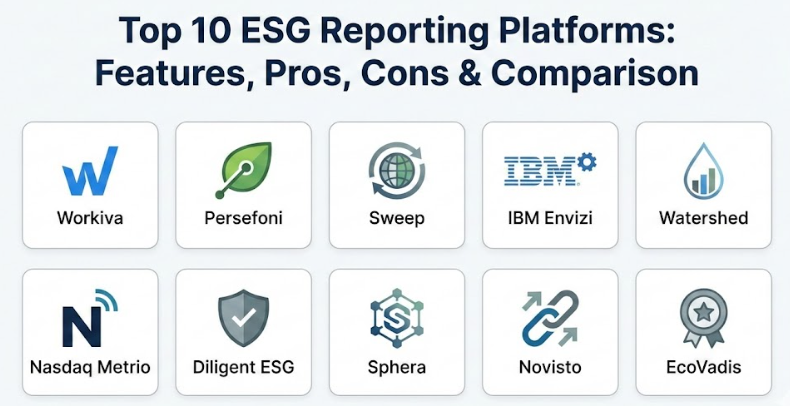
Top 10 ESG Reporting Platforms Tools
1 — Workiva
Workiva is a comprehensive cloud platform that brings together financial reporting, environmental tracking, and risk management in one place. It is built for teams that need to ensure their sustainability data is just as accurate and reliable as their financial statements.
Key features:
- Integrated reporting that connects financial and non-financial data.
- Automated data collection from various business systems.
- Support for major global frameworks like GRI, SASB, and TCFD.
- Built-in audit trails to track every change made to a document.
- Real-time collaboration tools for multiple departments to work together.
- Advanced tagging for digital filings to meet regulatory requirements.
Pros:
- Excellent for companies that already use Workiva for financial reporting.
- High level of accuracy and control over data.
Cons:
- Can be complex to set up initially for smaller teams.
- Higher price point compared to basic tracking tools.
Security & compliance: Offers SOC 1 and SOC 2 Type II reports, GDPR compliance, and data encryption both at rest and in transit.
Support & community: Provides 24/7 technical support, a dedicated success manager for enterprise clients, and an extensive online learning portal.
2 — Persefoni
Persefoni is a platform specifically focused on carbon accounting and climate management. It uses an AI-driven approach to help companies calculate their carbon footprint across their entire value chain with high precision.
Key features:
- Automated carbon footprint calculations based on the GHG Protocol.
- AI-powered data ingestion to reduce manual entry errors.
- Detailed tracking of Scope 1, 2, and 3 emissions.
- Tools for managing and engaging with suppliers on their climate data.
- Scenario modeling to help plan future carbon reduction strategies.
- Investment portfolio tracking for financial institutions.
Pros:
- Extremely strong in carbon-specific metrics and calculations.
- Very user-friendly interface that simplifies complex accounting.
Cons:
- Narrower focus on “E” (Environmental) compared to “S” and “G” metrics.
- May require additional tools for full governance and social reporting.
Security & compliance: SOC 2 Type II certified, GDPR compliant, and utilizes secure cloud infrastructure.
Support & community: Offers a thorough knowledge base, professional services for onboarding, and regular webinars on climate regulations.
3 — Sweep
Sweep is a modern sustainability data platform designed to help companies manage their carbon emissions and wider ESG goals. It emphasizes collaboration and is particularly useful for businesses with many different branches or a large network of partners.
Key features:
- Collaborative workspaces for different teams and locations.
- Direct data connections to business software and utility providers.
- Tracking for both corporate emissions and product-level impacts.
- Customizable surveys to gather information from suppliers.
- Dashboard views that show progress toward specific targets.
- Compliance tools for regional and international reporting rules.
Pros:
- Highly flexible and scales well as a company grows.
- Visual dashboards make it easy to explain data to stakeholders.
Cons:
- The level of customization can be overwhelming at first.
- Some advanced features are locked behind higher-tier plans.
Security & compliance: ISO 27001 certified, GDPR compliant, and features single sign-on (SSO) capabilities.
Support & community: Strong emphasis on customer success with dedicated support teams and a growing community of sustainability professionals.
4 — IBM Envizi
IBM Envizi is a powerful suite of tools that focuses on data management and analytics. It is often used by organizations with a large physical footprint, such as those in real estate or manufacturing, to monitor energy use and environmental impact.
Key features:
- Automated capture of utility and energy data.
- Advanced analytics for identifying energy-saving opportunities.
- Support for a wide range of ESG frameworks and disclosure types.
- AI-assisted data categorization to speed up reporting.
- Detailed reporting for individual facilities or entire portfolios.
- Integration with other IBM business and asset management tools.
Pros:
- Very powerful for handling massive amounts of granular energy data.
- Deep integration options for companies already in the IBM ecosystem.
Cons:
- The interface can feel more technical and “industrial” than others.
- Setup often requires significant IT involvement.
Security & compliance: SOC 2 Type II certified, follows IBM’s global security standards, and offers robust audit logs.
Support & community: Enterprise-level support with global coverage and extensive technical documentation.
5 — Watershed
Watershed is an enterprise climate platform that helps companies measure, report, and reduce their carbon footprint. It is built for speed and accuracy, often serving high-growth tech companies and large global brands.
Key features:
- High-speed data processing for large datasets.
- Marketplace for high-quality carbon offsets and removal projects.
- Detailed dashboards for tracking progress against “Net Zero” goals.
- Science-based target setting and tracking tools.
- Automated reporting for climate-related disclosures.
- Supplier engagement tools to clean up the value chain.
Pros:
- Very fast implementation compared to traditional enterprise software.
- Excellent data visualization for executive presentations.
Cons:
- Pricing is not public and can be high for mid-market firms.
- Primarily focused on climate and carbon rather than broad social metrics.
Security & compliance: SOC 2 Type II compliance and high-standard data encryption.
Support & community: High-touch support with dedicated climate advisors and sustainability experts.
6 — Nasdaq Metrio
Nasdaq Metrio is an all-in-one sustainability platform designed to streamline the way companies collect and share their ESG data. It focuses on making the data useful for investors and internal decision-makers alike.
Key features:
- Centralized data repository for all ESG information.
- Mapping tools to see how data fits across different frameworks.
- Interactive microsites for public sustainability reporting.
- Automated survey management for internal and external data.
- Peer benchmarking to see how you compare to industry rivals.
- Goal tracking with real-time progress updates.
Pros:
- Great for companies that need to communicate directly with investors.
- Simplifies the process of reporting to multiple frameworks at once.
Cons:
- Some users find the analytics tools less advanced than competitors.
- The setup of custom taxonomies can be a bit clunky.
Security & compliance: Backed by Nasdaq’s security infrastructure, including SSO and detailed access controls.
Support & community: Responsive customer support and regular updates based on new regulations.
7 — Diligent ESG
Diligent ESG is part of a larger governance and risk management suite. It is ideal for boards and leadership teams that want to integrate sustainability into their overall business strategy and oversight.
Key features:
- Direct integration with board management and risk tools.
- Real-time monitoring of carbon footprints and social metrics.
- Built-in benchmarking against thousands of other companies.
- Automated alerts when metrics fall outside of set targets.
- Audit-ready reports for all major global standards.
- Regulatory tracking to stay ahead of changing laws.
Pros:
- Best-in-class for governance-focused reporting and oversight.
- Easy for executives to use and understand.
Cons:
- Might be too broad if you only need a simple carbon calculator.
- The sheer number of features can make navigation a bit slow.
Security & compliance: ISO 27001, SOC 2, and high-level encryption suitable for government and finance.
Support & community: 24/7 global support and a large network of governance professionals.
8 — Sphera
Sphera offers a deep, operationally-focused platform that is widely used in heavy industries. It excels at managing complex environmental data, safety records, and product life cycle assessments.
Key features:
- Life Cycle Assessment (LCA) tools for individual products.
- Integration with health and safety (EHS) data.
- Massive database of emission factors and environmental impact data.
- Real-time risk assessment for industrial operations.
- Automated reporting for specialized industry regulations.
- Deep supply chain visibility and risk mapping.
Pros:
- Unmatched depth for industrial and manufacturing companies.
- Reliable data backed by decades of environmental research.
Cons:
- Steep learning curve for non-technical users.
- Interface can feel dated compared to newer cloud-native tools.
Security & compliance: Enterprise-grade security with SOC 2 compliance and rigorous data privacy controls.
Support & community: Expert consulting services available to help with complex implementations.
9 — Novisto
Novisto is a collaborative ESG platform that focuses on “smart” data management. It is designed to help sustainability teams move away from chasing data and focus more on creating value and impact.
Key features:
- Collaborative workflow tools to assign data tasks to others.
- Intuitive data entry with automated validation checks.
- Centralized hub for all ESG documentation and evidence.
- Benchmarking tools to analyze performance against peers.
- Flexible reporting templates for internal and external use.
- Historical data tracking to see long-term trends.
Pros:
- Very user-friendly and easy for teams to adopt quickly.
- High emphasis on data quality and auditability.
Cons:
- Newer platform, so some niche features are still in development.
- Integration with very old legacy systems can be difficult.
Security & compliance: SOC 2 Type II certified and GDPR compliant.
Support & community: Highly praised customer support team that is very responsive.
10 — EcoVadis
EcoVadis is slightly different from others as it is primarily a rating and assessment platform. It is the gold standard for companies that need to prove their sustainability credentials to their customers and business partners.
Key features:
- Detailed evidence-based sustainability ratings.
- Actionable improvement plans for rated companies.
- Global network of thousands of rated businesses.
- Specific modules for carbon action and supply chain risk.
- Benchmarking against industry-specific averages.
- Integration with procurement software and platforms.
Pros:
- The most recognized name for supplier sustainability assessments.
- Provides a clear score that is easy to share and understand.
Cons:
- Less of a “management” tool and more of an “assessment” tool.
- Requires a lot of manual document uploading during the rating process.
Security & compliance: ISO 27001 certified and follows strict data privacy rules for sensitive supplier info.
Support & community: Extensive multi-language support and a massive global user base.
Comparison Table
| Tool Name | Best For | Platform(s) Supported | Standout Feature | Rating |
| Workiva | Financial-grade Reporting | Web / Cloud | Audit Trail & XBRL | 4.6 |
| Persefoni | Carbon Accounting | Web / Cloud | AI Carbon Ingestion | 4.5 |
| Sweep | Collaborative Teams | Web / Cloud | Multi-location Hubs | 4.7 |
| IBM Envizi | Energy & Facilities | Web / Cloud | Utility Bill Automation | 4.4 |
| Watershed | Climate Strategy | Web / Cloud | Net Zero Planning | 4.6 |
| Nasdaq Metrio | Investor Relations | Web / Cloud | Stakeholder Microsites | 4.4 |
| Diligent ESG | Board Governance | Web / Cloud | GRC Integration | 4.5 |
| Sphera | Industrial Operations | Web / Cloud / On-prem | Product LCA Database | 4.3 |
| Novisto | Data Quality | Web / Cloud | Collaborative Workflows | 4.5 |
| EcoVadis | Supplier Ratings | Web / Cloud | Global Sustainability Score | 4.7 |
Evaluation & Scoring of ESG Reporting Platforms
To help you understand how these tools compare, we have used a weighted scoring system based on the key areas that matter most to businesses today.
| Evaluation Category | Weight | Description |
| Core Features | 25% | Ability to handle carbon, social, and governance data effectively. |
| Ease of Use | 15% | How intuitive the interface is for non-technical employees. |
| Integrations | 15% | Ability to connect with ERPs, HR software, and utility providers. |
| Security | 10% | Encryption, certifications (SOC 2, ISO), and data privacy. |
| Performance | 10% | System speed and reliability when handling large datasets. |
| Support | 10% | Quality of onboarding, documentation, and customer service. |
| Price / Value | 15% | Balance between the cost of the tool and the benefits provided. |
Which ESG Reporting Platforms Tool Is Right for You?
Choosing the right platform depends heavily on your current stage of sustainability maturity and your specific business goals.
Solo Users and SMBs
If you are a smaller business just starting out, you might not need a massive enterprise suite. Tools like Greenly or the basic versions of Sweep are often better fits because they focus on getting you up and running quickly with carbon tracking without requiring a team of experts to manage the software.
Mid-Market Companies
For companies that are growing and starting to face more pressure from customers or regulators, a tool like Novisto or Nasdaq Metrio offers a great balance. These platforms are powerful enough to handle complex data but are still user-friendly enough that a small sustainability team can manage them effectively.
Enterprise and Large Corporations
If you are a global organization with thousands of employees and complex operations, you need a heavy-hitter like Workiva, IBM Envizi, or Sphera. These tools are built to handle massive amounts of data across different countries and languages, and they offer the highest levels of security and auditability.
Focus on Strategy vs. Compliance
- Compliance-Heavy: If your main goal is to meet strict financial and regulatory filing rules, Workiva is likely your best choice.
- Strategy-Heavy: If you want to use your data to drive massive changes in your carbon footprint and reach “Net Zero,” Watershed or Persefoni will provide the specific climate tools you need.
- Supply Chain-Heavy: If you need to manage thousands of suppliers and understand their impact, EcoVadis or Sweep are the leaders in this area.
Frequently Asked Questions (FAQs)
What is the main benefit of using an ESG platform over a spreadsheet?
A platform reduces manual errors, provides a central place for all data, and creates audit trails. This makes your reporting more reliable and much easier for third parties to verify during an audit.
How long does it take to implement an ESG reporting tool?
Simple tools can be set up in a few weeks, while large enterprise systems can take several months. It usually depends on how organized your data is before you start the process.
Can these tools help with Scope 3 emissions?
Yes, most top platforms now include specific features to track Scope 3 emissions, which are the indirect impacts in your supply chain. This is often the most difficult part of carbon accounting.
Do I need a consultant to help me use these platforms?
While many platforms are designed to be user-friendly, many companies still hire a consultant for the initial setup to ensure they are picking the right metrics and following the correct frameworks.
Are these platforms secure for sensitive company data?
Most leading platforms use enterprise-grade security, including SOC 2 Type II certification and encryption. This ensures that your private business information is protected from unauthorized access.
How much do ESG reporting platforms cost?
Pricing varies widely based on the size of your company and the features you need. Most providers offer custom quotes rather than fixed public pricing, but you should expect to pay more for higher levels of automation and support.
Which reporting frameworks do these tools support?
Most support all major global standards, including GRI, SASB, TCFD, and the newer CSRD requirements. It is always best to check with the provider if they support the specific rules in your region.
Can I integrate my existing accounting software?
Many platforms offer APIs or direct integrations with popular ERP and accounting systems like SAP, Oracle, or Microsoft Dynamics. This allows for automated data flows that save time and reduce errors.
What is the difference between carbon accounting and ESG reporting?
Carbon accounting is specifically about measuring greenhouse gas emissions. ESG reporting is broader and includes social factors like employee safety and governance factors like board diversity.
Can these tools help me improve my ESG score?
While the tool itself doesn’t change your performance, it gives you the data needed to see where you are falling behind. By identifying these gaps, you can take action to improve your scores over time.
Conclusion
Selecting an ESG reporting platform is a significant step toward making your business more transparent and responsible. These tools do much more than just help you write a report; they provide the insights needed to manage risks, find efficiencies, and build trust with your stakeholders. Whether you are focused on lowering your carbon footprint, improving your supply chain, or meeting new government regulations, there is a tool designed for your specific needs.
What matters most is choosing a platform that fits your current size while having the ability to grow with you. There is no single “perfect” tool for everyone. Instead, the best choice is the one that aligns with your company’s goals, integrates well with your existing systems, and provides the level of data accuracy you need. By investing in the right platform now, you are setting your organization up for long-term success in an increasingly sustainability-conscious world.