Introduction
HR Analytics Platforms are specialized software tools that help companies collect, organize, and study data about their workers. Instead of just keeping a list of names and salaries in a folder, these platforms look at patterns to show how a business is really doing. They take raw information—like how many people are joining, how many are leaving, and how much work is getting done—and turn it into clear charts and stories. By using these tools, a manager can understand why a team is unhappy or why it takes so long to hire someone new. They act like a digital helper that takes the guesswork out of managing people, allowing leaders to make choices based on facts rather than just a feeling. These systems act as a central hub where all information about the workforce is kept safe and organized, making it easy for anyone with permission to find the answers they need in seconds. Instead of spending days looking through spreadsheets, an HR professional can simply click a button to see the health of the entire company.
HR Analytics Platforms are important because they bring all of a company’s people-data into one single, easy-to-read dashboard. This allows leaders to see the “big picture” of their workforce in real-time. Whether a company is trying to improve diversity, lower its hiring costs, or figure out which training programs are actually helping staff, these platforms provide the evidence needed to make the right move. They allow a business to be proactive, fixing problems like low morale or high turnover before they become major crises that hurt the bottom line.
Key real-world use cases for these tools include predicting employee turnover, identifying future leaders within the staff, and measuring the success of remote work policies. Organizations also use them to ensure that pay is fair across different genders and backgrounds. When you are looking for a tool in this category, you should evaluate it based on several criteria: how easily it connects to your existing payroll software, the quality of its visual reports, and how simple it is for a non-technical person to navigate. It is also vital to check if the platform can grow alongside your company, as a tool that works for fifty people might not handle the complexity of five thousand. High-quality support and a strong user community are also signs that a platform is a reliable partner for the long term.
Best For and Not Ideal For
Best for: These tools provide the most value to medium and large-sized companies that have hundreds or thousands of employees across different locations. Roles like HR Directors, People Analysts, and C-level executives benefit the most because they need high-level insights to steer the company. Organizations in fast-growing industries like technology, healthcare, and professional services find them indispensable for managing rapid hiring and retention. They are also perfect for companies that want to move away from messy spreadsheets and toward a more organized, data-driven way of working.
Not ideal for: Very small businesses or startups with only a handful of employees probably do not need a dedicated analytics platform. If you can track your team’s progress on a simple whiteboard or a basic spreadsheet, the cost and setup time for these tools might be a waste of resources. Additionally, companies that do not have a dedicated person to look at the data might find the information overwhelming and difficult to act upon. If your business is still using paper records for everything, you should focus on basic digital record-keeping before trying to implement advanced analytics.
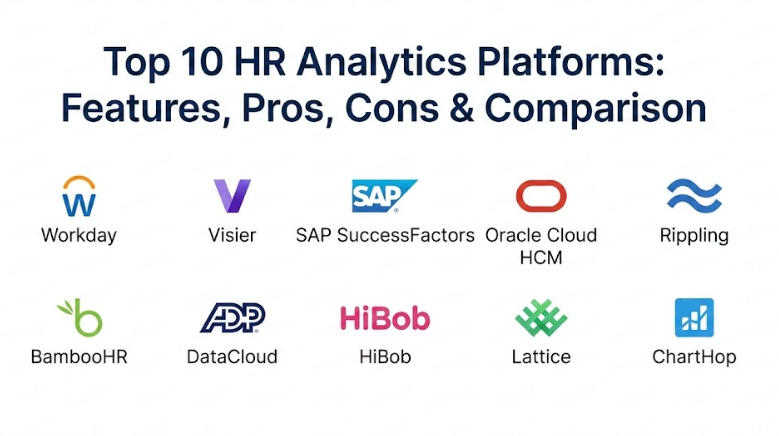
Top 10 HR Analytics Platforms Tools
1 — Workday Human Capital Management
Workday is a heavy-duty, all-in-one system designed for large, global organizations that want to keep their HR and financial data in the same place. It is widely considered a leader for enterprise businesses because it handles everything from basic payroll to deep, predictive analytics. Because it is so large, it can manage the complex rules and laws of many different countries at the same time. It is built to be a permanent solution for companies that never want to switch software again, providing a solid foundation for every part of the employee journey.
- Key Features:
- A single system for HR, payroll, and financial planning.
- Predictive tools that warn you if a high-performing employee might quit soon.
- Deep learning models that suggest internal candidates for open roles.
- Real-time organization charts that show the entire company structure.
- Automated compliance tracking for local labor laws across the globe.
- Advanced reporting that allows you to “slice and dice” data by location or department.
- Customizable employee self-service portals for benefits and time-off.
- Pros:
- It provides a complete “single source of truth” for all company data.
- The platform is incredibly secure and can handle the data of hundreds of thousands of workers.
- Regular updates ensure that the system is always using the latest technology and keeping up with new laws.
- Cons:
- The initial setup is very expensive and can take many months to complete.
- It is often too complex and “heavy” for smaller businesses that just need simple reports.
- Security & Compliance: Top-tier security including SOC 2, ISO 27001, and full GDPR compliance with advanced data encryption.
- Support & Community: Large global community, extensive training materials, and dedicated account managers for enterprise clients.
2 — Visier People
Visier is a specialized tool that focuses entirely on analytics rather than being a general HR system. It is designed to sit on top of your existing software, pulling data from various sources to give you a deep look into your workforce. It is famous for its “instant answers,” where a user can type a question and receive a beautiful chart as an answer. This platform is perfect for companies that already have employee records but don’t know how to turn them into useful insights for the leadership team.
- Key Features:
- Pre-built “stories” and dashboards that answer common HR questions immediately.
- Detailed benchmarking that lets you compare your company to others in your industry.
- “What-If” modeling to see how a change in pay or hiring would affect the budget.
- Tools focused specifically on Diversity, Equity, and Inclusion (DEI) tracking.
- Automated data cleaning that fixes mistakes in your employee records.
- Retention tracking that identifies the exact reasons why people choose to leave.
- Easy sharing tools so HR can send reports directly to other executives.
- Pros:
- The visual charts are among the easiest to read and understand in the market.
- You don’t need to be a data expert to find deep and meaningful insights.
- It can connect to many different HR systems at once, bringing all your data together.
- Cons:
- It does not handle payroll or daily HR tasks, so you still need another system for those.
- The price can be high because it is a premium, specialized product.
- Security & Compliance: SOC 2 Type II certified, fully GDPR compliant, and uses strict role-based access controls.
- Support & Community: High-quality onboarding assistance and an active community of people-analytics professionals.
3 — SAP SuccessFactors
SAP SuccessFactors is a global leader that helps massive companies manage their employees across every continent. It is part of the larger SAP family, making it the natural choice for businesses that already use SAP for their accounting or supply chain. The platform is known for being extremely robust and capable of handling the most difficult legal and tax requirements found anywhere in the world. It provides a detailed view of an employee’s entire journey, from their first interview to the day they retire, ensuring that every piece of data is tracked and analyzed.
- Key Features:
- Global “People Insights” that provide reports across different regions and languages.
- Succession planning tools to prepare for when key leaders leave the company.
- Performance management that connects individual goals to company success.
- Learning management system (LMS) to track employee training and skills.
- Recruitment analytics that show where your best candidates are coming from.
- Compensation modeling to ensure fair pay across the entire organization.
- Total workforce management that includes both full-time staff and contractors.
- Pros:
- Excellent at handling the legal and administrative complexity of global business.
- The system is very stable and can manage millions of data points without slowing down.
- Deep integration with other SAP business software makes data sharing easy.
- Cons:
- The user interface can feel a bit older and more “corporate” than newer apps.
- Changes and customizations often require technical experts to implement.
- Security & Compliance: Meets the highest global standards, including ISO and SOC, with specialized settings for regional privacy laws.
- Support & Community: Enterprise-grade support with a huge network of global partners and professional consultants.
4 — Oracle Fusion Cloud HCM
Oracle Fusion Cloud HCM is a powerful platform that is often favored by large companies with strong IT departments. It uses advanced artificial intelligence to help managers make better decisions about their teams. The system is built to be a “rock-solid” foundation for an enterprise, focusing heavily on security and the ability to process massive amounts of data. It is a comprehensive suite that doesn’t just track data but actively suggests ways to improve the business by identifying patterns that a human might miss.
- Key Features:
- AI-powered suggestions that recommend the best internal person for a promotion.
- “Workforce Health and Safety” modules to track incidents and safety training.
- Strategic workforce planning that aligns hiring with the company’s financial goals.
- Employee sentiment analysis that uses surveys to track how people are feeling.
- Advanced controls that help prevent fraud and errors in the HR system.
- Real-time reporting that updates the moment a change is made.
- Mobile-first design that allows managers to see data on their phones.
- Pros:
- Incredible data security and reliability that is trusted by government agencies.
- The AI features are genuinely helpful for finding trends that save time and money.
- It integrates perfectly with Oracle’s other business and finance tools.
- Cons:
- It has a steep learning curve and requires significant training for new users.
- The system can feel overwhelming because it has so many features and settings.
- Security & Compliance: Extensive certifications including SOC 1/2, ISO, HIPAA, and various government-level standards.
- Support & Community: Large-scale enterprise support with a very deep online library of technical guides.
5 — Rippling
Rippling is a modern, fast-growing platform that combines HR, Information Technology (IT), and Finance into one place. It is unique because it can track how much you are spending on software for each employee alongside their performance data. This tool is built to be extremely fast and easy to use, making it a favorite for modern tech companies and mid-sized businesses. It automates much of the “busywork” of HR, like setting up new computers and payroll for new hires, and gives you instant reports on the total cost of each team.
- Key Features:
- Unified reporting that combines HR data, IT device tracking, and company spending.
- “Recipes” that allow you to automate tasks when a certain data point is reached.
- Global payroll that can pay employees and contractors in many countries with one click.
- Simple dashboard creation that doesn’t require any technical skill.
- Over 500 integrations with other software apps like Slack and Google Workspace.
- Automated compliance alerts that tell you when a labor law changes in a specific state.
- Time and attendance tracking that flows directly into payroll and analytics.
- Pros:
- It is one of the fastest platforms to set up and start using today.
- The modern interface is very clean and easy for everyone to navigate.
- Automation features save hours of manual data entry every single week.
- Cons:
- The cost can go up quickly as you add more modules for IT and Finance.
- It might not have the extreme depth of reporting needed by a dedicated data scientist.
- Security & Compliance: SOC 2 certified, uses 256-bit encryption, and offers very strong Single Sign-On (SSO) features.
- Support & Community: Helpful online chat support and a very large library of “how-to” articles for self-service.
6 — BambooHR
BambooHR is the go-to choice for small and medium-sized businesses that want to get organized but don’t want a complicated system. Its analytics are focused on the “heart” of the business—helping managers understand how their people are doing. The platform is designed to be friendly and approachable, focusing more on the human side of work than just cold numbers. It is an excellent choice for companies that are transitioning from spreadsheets to their first real HR system and want to see immediate benefits.
- Key Features:
- “HR Experience” dashboards that show employee turnover and retention clearly.
- Simple Employee Satisfaction (eNPS) surveys to track company morale.
- Easy-to-run reports for standard legal requirements like equal opportunity.
- Time-off tracking and leave balance reports that are easy for staff to use.
- Applicant Tracking System (ATS) that shows which hiring sources are best.
- Performance review tools that summarize employee growth over time.
- A mobile app that allows employees to access their information anywhere.
- Pros:
- Extremely user-friendly; most people can learn it in a single afternoon.
- Great value for the price, especially for businesses with 50 to 500 employees.
- The company has a reputation for very friendly and helpful customer service.
- Cons:
- The analytics are not as deep or customizable as specialized tools like Visier.
- It is not built to handle the complex needs of massive, global corporations.
- Security & Compliance: SOC 2 Type II certified and takes data privacy very seriously for small business clients.
- Support & Community: Active user forums and a well-known customer success team that is easy to reach.
7 — ADP DataCloud
ADP is one of the oldest and largest payroll companies in the world, and their DataCloud platform uses their massive amount of data to provide unique insights. It is particularly good for “benchmarking,” which means comparing your company’s pay and turnover to other similar businesses. Because ADP pays so many people globally, they can tell you if your salaries are too low or if your staff is quitting more often than the industry average. This helps businesses stay competitive in a crowded job market where every talent counts.
- Key Features:
- Benchmarking tools that compare your data to real-time industry averages.
- Pay equity analysis to find and fix unfair wage gaps in your company.
- Predictive models that warn you when turnover is likely to increase.
- Labor cost tracking to see exactly where your budget is being spent.
- Turnover analysis that breaks down why people are leaving by location or role.
- Strategic hiring insights that help you find talent in specific geographic areas.
- Executive-level dashboards that summarize the health of the entire business.
- Pros:
- The industry benchmarking data is the most accurate in the market.
- It integrates perfectly with ADP payroll, which many large companies already use.
- Great for identifying exactly where you are losing money on labor costs.
- Cons:
- The interface can feel a bit old-fashioned and “heavy” to navigate.
- Customer support can sometimes be slower because the company is so large.
- Security & Compliance: World-class security with SOC, ISO, and global financial-grade compliance standards.
- Support & Community: Massive support infrastructure with specialized experts for different industries.
8 — HiBob
HiBob, often called “Bob,” is a modern platform built for companies that prioritize their culture and employee engagement. It is designed to feel like a social media app, which makes employees more likely to use it and share their thoughts. This creates better data for the HR team because they get more honest feedback from their staff than they would through a boring survey. It is an excellent choice for modern, global companies that want to keep a close-knit feel across different offices and remote teams.
- Key Features:
- Visual “People Graphs” that make complex data feel human and easy to see.
- Culture-focused features like “shout-outs” and social clubs for employees.
- Advanced tracking for Diversity, Equity, and Inclusion (DEI) goals.
- Compensation management that links performance scores to pay raises.
- Global workforce planning tools that help you model future team growth.
- Integrations with popular office tools like Slack and Microsoft Teams.
- Detailed “Lifecycle” reports that track an employee’s journey from day one.
- Pros:
- The beautiful, modern design makes it a pleasure for employees to use.
- Very flexible and allows you to track the specific culture-metrics you care about.
- Excellent for global teams that want to maintain a consistent company culture.
- Cons:
- The “social” feel might not be a fit for very traditional or formal industries.
- Some of the most advanced analytics are only available on the more expensive plans.
- Security & Compliance: SOC 2 Type II, ISO 27001, and fully GDPR compliant.
- Support & Community: Focused on “customer success” with a modern, responsive support team.
9 — Lattice
Lattice is a platform that focuses specifically on performance and employee growth. It is unique because it connects how people feel (engagement) with how they are actually doing (performance). This allows a company to see if their top-performing employees are happy or if they are at risk of burning out. It is a very powerful tool for companies that want to build high-performing teams and help their managers become better leaders by providing them with clear feedback loops and actionable data.
- Key Features:
- Dashboards that connect employee engagement scores to performance ratings.
- Goal and OKR (Objectives and Key Results) tracking for every team member.
- Predictive analytics that identify high-potential employees for future leadership.
- Manager effectiveness tracking to see who is leading their teams best.
- Detailed turnover analysis linked to performance and management data.
- Tools for career pathing that show employees how they can grow in the company.
- DEI dashboards that track diversity within different performance levels.
- Pros:
- It is one of the best tools for helping managers improve their team’s results.
- The clean and simple design makes difficult data feel easy to understand.
- Excellent for building a culture of growth, feedback, and accountability.
- Cons:
- It is not a complete HR system, so you still need a different tool for payroll.
- You often need to connect it to another database to get the full picture of your staff.
- Security & Compliance: SOC 2 Type II certified and follows all standard global data privacy rules.
- Support & Community: Very strong community resources, including popular blogs and events for HR leaders.
10 — ChartHop
ChartHop is a specialized tool that focuses on “workforce visualization.” It is built around a dynamic, interactive organization chart that shows every piece of employee data visually. Instead of looking at a spreadsheet, you can see a map of your company that shows who everyone reports to, how much they are paid, and how they are performing. It is a perfect tool for planning how your company will grow and change in the future without getting lost in the numbers.
- Key Features:
- Interactive org charts that allow you to click on any person to see their data.
- “Scenario Planning” that lets you visually map out a reorganization before doing it.
- Real-time tracking of headcount and how much the company is spending on staff.
- Diversity overlays that show DEI data directly on the company map.
- Automated syncing with your payroll and HR software to keep data current.
- Compensation planning tools that show you if your pay is fair across the chart.
- Open and transparent reporting that can be shared with the whole staff if desired.
- Pros:
- It is the most visual and easy way to plan for company growth.
- Makes it very simple to spot gaps in your budget or your team structure.
- Highly transparent, which is great for modern and open company cultures.
- Cons:
- It works best when connected to another HR system rather than being used alone.
- The focus is more on future planning than on studying deep historical data.
- Security & Compliance: SOC 2 certified and uses strong encryption to protect sensitive pay information.
- Support & Community: A growing community of users and personalized help for new customers.
Comparison Table
| Tool Name | Best For | Platform(s) Supported | Standout Feature | Rating |
| Workday | Global Enterprises | Cloud / Web / Mobile | Unified Finance & HR | 4.4 / 5 |
| Visier | Data-Driven HR Teams | Cloud / Web | Predictive Modeling | 4.7 / 5 |
| SAP SuccessFactors | Global Organizations | Cloud / Web / Mobile | Global Compliance | 4.0 / 5 |
| Oracle HCM | Large Corporate IT | Cloud / Web | AI-Powered Insights | 4.7 / 5 |
| Rippling | Fast-Growing SMBs | Cloud / Web / Mobile | Unified IT & HR | 4.8 / 5 |
| BambooHR | Growing SMBs | Cloud / Web / Mobile | Ease of Use | 4.4 / 5 |
| ADP DataCloud | Benchmark Seekers | Cloud / Web / Mobile | Global Benchmarking | 4.3 / 5 |
| HiBob | Culture-First Teams | Cloud / Web / Mobile | Modern UI & Culture | 4.5 / 5 |
| Lattice | Performance Focused | Cloud / Web / Mobile | Goal & OKR Tracking | 4.6 / 5 |
| ChartHop | Visual Planning | Cloud / Web | Visual Org Charting | 4.6 / 5 |
Evaluation & Scoring of HR Analytics Platforms
To choose the best platform, we evaluate them across several key areas. Each area is weighted based on how much it typically affects the success of a business and the happiness of the HR team.
| Criteria | Weight | What We Evaluate |
| Core Features | 25% | The depth of reporting, predictive tools, and data visualization quality. |
| Ease of Use | 15% | How simple it is for a regular HR person to learn and navigate the system. |
| Integrations | 15% | How well the tool connects to payroll, finance, and hiring software. |
| Security & Compliance | 10% | Encryption standards and certifications like SOC 2 and GDPR. |
| Performance & Reliability | 10% | System uptime and how quickly the dashboards load and update. |
| Support & Community | 10% | The quality of help documentation and the speed of customer service. |
| Price / Value | 15% | Whether the benefits provided justify the monthly or annual cost. |
Which HR Analytics Platforms Tool Is Right for You?
The right choice depends on your specific needs, your budget, and the size of your team. Here is a practical guide to help you decide.
Company Size and Market
- Small Businesses (under 50 people): You might find BambooHR to be the best fit. It is affordable and gives you exactly what you need without being too complex for a small team to manage.
- Mid-Market (50 to 500 people): Rippling or HiBob are excellent choices. They offer a great balance of modern features and easy automation that saves time for busy HR managers.
- Large Enterprises (1,000+ people): You need the power of Workday, SAP, or Oracle. These are built to handle massive data sets and the legal complexity of many different countries.
Budget vs. Feature Depth
- Budget-Conscious: If you need to keep costs low, stick with the basic reporting built into your payroll system or use a simple tool like BambooHR. You can always upgrade as your needs grow.
- Premium Insights: If you have the budget and want the most advanced data possible, Visier is the top choice. It costs more but provides the deepest insights into your people and their habits.
Specific Goals
- Improving Performance: If your main goal is to help managers and employees grow, Lattice is the specialist you need to build a high-performance culture.
- Planning for Growth: If you are hiring quickly and need to visualize your future structure, ChartHop is the best tool for the job.
- Comparing to Competitors: If you want to know if your pay is fair compared to others, ADP DataCloud has the best benchmarking data in the industry.
Frequently Asked Questions (FAQs)
1. What exactly is an HR Analytics Platform?
It is a software tool that gathers information about your employees—like who is joining, who is leaving, and how much they are paid—and turns it into charts. This helps managers understand their workforce and make better decisions based on real facts instead of just guessing or using their intuition.
2. Is my employee data safe in these systems?
Yes, most reputable platforms use very strong security measures similar to those used by banks. You should look for certifications like “SOC 2” or “ISO 27001,” which mean that outside experts have checked the company’s security to ensure your data is protected and kept private at all times.
3. Do I need to be a math expert to use these tools?
Not at all. Most modern platforms, especially ones like BambooHR or HiBob, are designed for regular people to use without any special training. They do all the hard math in the background and show you the results in easy-to-read graphs and simple sentences that anyone can understand.
4. How long does it take to set up one of these platforms?
It depends on the tool you choose. A simple platform for a small company can be set up in a few days. However, a massive system for a global corporation can take many months because it has to connect to many other financial and legal systems across different regions.
5. Can these tools really help stop people from quitting?
Yes, they can. Many platforms have “predictive analytics” that look for signs that an employee might be unhappy—like if they haven’t had a raise in a long time or if their engagement scores are dropping. This gives managers a chance to talk to them and help before the person decides to leave.
6. Will the tool connect to my current payroll software?
Most platforms are built to “talk” to other software. You should always ask for a list of “native integrations” before you buy. Some tools, like Rippling, actually include payroll as part of the system, so you don’t even need to worry about connecting a separate one.
7. How much do these platforms usually cost?
Most charge a monthly fee based on how many employees you have. A simple tool might cost $5 to $12 per person each month, while a very advanced enterprise system can be much more expensive. Many also have a one-time fee to help you get everything set up correctly at the start.
8. Can I use these tools on my phone?
Almost all modern HR platforms have a mobile app or a website that works perfectly on a phone. This is very helpful for busy managers who need to check a report during a meeting or for employees who want to check their pay or request time off while they are away from their desks.
9. Can these tools help with diversity and inclusion?
Yes, this is one of their most important uses today. These platforms can show you if you are hiring a diverse group of people, if everyone is being paid fairly, and if different groups of employees are being promoted at the same rate, helping you build a fairer workplace.
10. What is the most common mistake people make when buying a tool?
Buying a system that is too complicated for their team to actually use on a daily basis. It is much better to have a simple tool that your team uses every day than a very powerful tool that sits empty because no one understands how to run a basic report or find a chart.
Conclusion
Choosing the right HR Analytics Platform is a major step toward building a more successful and fair business. These tools allow you to move away from old-fashioned paperwork and “gut feelings,” replacing them with clear, actionable facts about your workforce. By investing in the right technology, you can significantly improve how you hire, train, and keep your most valuable resource: your employees. It is about more than just looking at charts; it is about understanding the human heart of your company and making sure that everyone has the support and the fairness they need to do their best work. When a business uses data to be more organized and more helpful to its staff, the whole company becomes stronger, more efficient, and more resilient for the future. Every decision you make using these tools is a step toward a better workplace where both the business and the people can thrive together.
When you begin your search for the perfect tool, remember that the “best” choice is the one that fits your unique company culture and your specific goals. A fast-growing tech startup might need the automation and speed of Rippling, while a massive global manufacturer will require the heavy-duty power and compliance of Workday or SAP. The most important thing is to focus on the questions you are trying to answer every day. Are you trying to lower your hiring costs? Do you want to fix your company culture? Or do you just need a better way to plan your budget for the next year? Do not get distracted by fancy features that you will never use; instead, look for a tool that makes your daily work easier and your team happier and more productive.
Take the time to watch several demos, ask deep questions about security, and make sure the tool can grow as your company grows. The right platform will not just give you a list of numbers; it will tell you the story of your business and show you exactly where you need to go next. In a world where every company is competing for the best talent, having the right data can be the difference between falling behind and leading the way in your industry. By making a thoughtful and informed choice, you are not just buying software; you are investing in the long-term health and success of your entire organization. Every report you run and every chart you share is a contribution to a more human-centered and successful workplace where every person’s contribution is recognized and valued.