Introduction
A Data Clean Room is a secure, controlled environment that allows multiple parties to collaborate on datasets while maintaining the absolute privacy of individual users. In the simplest terms, it is like a safe room where two people can compare notes through a frosted glass window: you can see the patterns and the totals, but you can never see the specific names or details on the other person’s paper. These tools are important because they solve the massive “privacy vs. personalization” conflict. Brands need to know if their marketing works, but they are no longer allowed to track individuals across the web using traditional methods.
Real-world use cases are expanding every day. A large clothing brand might use a clean room to match its customer list with a social media platform’s users to see who saw an ad and later bought a shirt. A pharmaceutical company might collaborate with a hospital to find patterns in patient recovery without ever seeing a single patient’s name. When choosing a tool in this category, you should look for privacy-enhancing technologies (PETs), the ease of integration with your existing cloud storage, and the scale of the partner ecosystem already available on the platform.
Best for: Data scientists, marketing directors, and privacy officers at mid-market to enterprise-level companies, particularly in retail, CPG, finance, and media. It is essential for any business that relies on high-volume customer data but needs to remain compliant with laws like GDPR and CCPA.
Not ideal for: Very small businesses or solo entrepreneurs who do not have large first-party datasets. For these users, traditional aggregated reporting from ad platforms or simple analytics tools are usually sufficient and far more cost-effective than the high-overhead of a dedicated clean room.
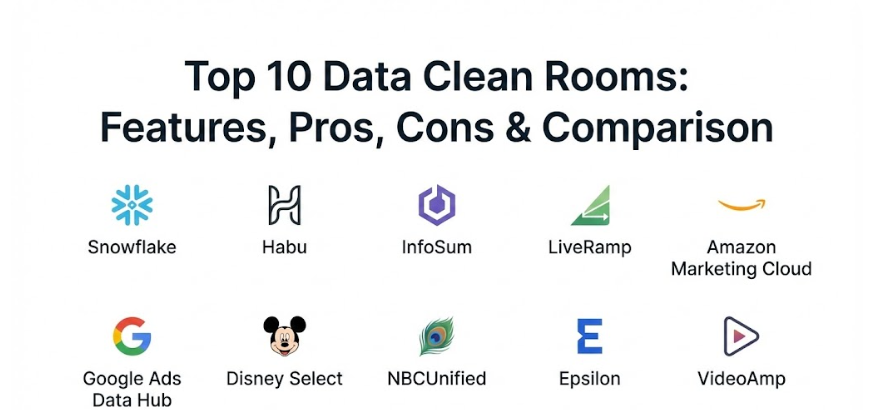
Top 10 Data Clean Rooms Tools
1 — Snowflake Data Clean Room
Snowflake has built its reputation as a “Data Cloud,” and its clean room functionality is a natural extension of its massive sharing ecosystem. It allows companies that already host their data on Snowflake to collaborate with partners instantly without moving any files. This tool is designed for technical teams who want high-performance queries and a “no-copy” architecture.
- Key features:
- No-Copy Data Sharing: Collaborate on data exactly where it sits without transferring files.
- Distributed Privacy Controls: Each party sets their own rules on what can be queried.
- Multi-Cloud Support: Works across AWS, Azure, and Google Cloud seamlessly.
- SQL-Based Analysis: Uses standard data language that most analysts already know.
- Scalable Compute: Handles massive datasets with the speed of the Snowflake engine.
- Global Governance: Automated tracking of who accessed what and when.
- Pros:
- If you already use Snowflake, the setup is incredibly fast and requires no new data pipelines.
- It offers some of the highest performance speeds for complex, large-scale data joins.
- Cons:
- It can be very expensive, as costs are tied to “compute credits” which can spike during heavy use.
- It requires technical staff who are comfortable with SQL and data architecture.
- Security & compliance: SOC 1 & 2 Type II, ISO 27001, HIPAA, GDPR, and FedRAMP compliant. Uses end-to-end encryption and robust SSO.
- Support & community: Extensive technical documentation, professional services, and a massive global community of data engineers.
2 — Habu
Habu is a specialized “orchestration” layer for clean rooms. It doesn’t necessarily store your data; instead, it provides a user-friendly interface to manage clean rooms across different clouds like Snowflake, AWS, and Google Ads Data Hub. It is designed for marketers who want a simpler way to manage complex privacy rules.
- Key features:
- Cross-Cloud Orchestration: Manage multiple clean rooms from one single dashboard.
- Automated Workflows: Pre-built templates for common tasks like “lookalike modeling.”
- Privacy-Safe Intelligence: Uses advanced math to ensure no individual can be re-identified.
- Partner Ecosystem: Easy “one-click” connections with many major media publishers.
- No-Code Interface: Allows non-technical marketers to run reports without writing SQL.
- Federated Queries: Analyze data in multiple locations simultaneously.
- Pros:
- The interface is much easier to use for marketing teams than raw cloud platforms.
- It saves massive amounts of time by automating the “plumbing” of setting up data connections.
- Cons:
- It is an additional cost on top of the cloud storage fees you are already paying.
- You are still limited by the underlying capabilities of the cloud where your data lives.
- Security & compliance: SOC 2 Type II compliant, GDPR and CCPA ready. Offers detailed audit logs and private-key encryption.
- Support & community: High-touch customer success teams and detailed onboarding for enterprise clients.
3 — InfoSum
InfoSum is famous for its “non-movement” approach to data. Their technology, called “bunkers,” ensures that data is never uploaded to a central server. Instead, the analysis happens locally within each partner’s own environment. This tool is designed for organizations with extremely high security requirements who never want their data to leave their premises.
- Key features:
- Bunker Technology: Each partner keeps their data in a private, local container.
- Mathematical Profiles: Only anonymized mathematical patterns are shared, never raw records.
- Instant Audience Discovery: See how many customers you share with a partner in seconds.
- Permission-Based Access: Grant or revoke access to specific datasets instantly.
- Multi-Party Collaboration: Connect three or more companies in one single clean room.
- Privacy-First Design: Built from the ground up to prevent data leakage by design.
- Pros:
- It is arguably the most secure option because the data literally never moves.
- The setup is very fast for media companies and publishers who use it as their standard.
- Cons:
- It has a unique learning curve as it functions differently than traditional SQL databases.
- The partner ecosystem, while growing, is smaller than the major cloud providers.
- Security & compliance: ISO 27001 certified, SOC 2 compliant, and fully aligned with GDPR’s “Privacy by Design” principles.
- Support & community: Provides professional onboarding and a dedicated support portal for enterprise users.
4 — LiveRamp Safe Haven
LiveRamp is a giant in the world of “identity resolution,” and its Safe Haven platform is built on top of that expertise. It allows brands to connect their data using LiveRamp’s unique “RampID,” which helps match customers across different platforms even if their email addresses don’t perfectly match.
- Key features:
- Identity Resolution: The industry’s best tools for matching different customer records.
- Global Reach: Access to thousands of brand and publisher partners.
- Pre-Built Modules: Specialized tools for retail media and CPG measurement.
- Privacy-Centric Workflow: Built-in safeguards to prevent the export of PII (Personally Identifiable Information).
- Activation Tools: Send your analysis directly to ad platforms to start a campaign.
- Data Enrichment: Ability to add third-party data to your clean room for better insights.
- Pros:
- If you need help “matching” your data with partners, LiveRamp is the best in the business.
- It has one of the largest networks of available partners in the world.
- Cons:
- The pricing can be complex and expensive for smaller organizations.
- It can be slower to set up than “no-copy” cloud-native clean rooms.
- Security & compliance: SOC 2 Type II, HIPAA, and GDPR compliant. Uses pseudonymization and robust encryption.
- Support & community: Extensive enterprise support, training programs, and a well-established user base.
5 — Amazon Marketing Cloud (AMC)
For any brand selling on Amazon, AMC is a mandatory tool. It is a clean room dedicated specifically to Amazon’s massive dataset. It allows advertisers to join their own sales data with Amazon’s advertising data to see the true “path to purchase.”
- Key features:
- Direct Amazon Integration: Access to all Amazon DSP and Sponsored Ads data.
- Custom Attribution: Build your own models to see which ads actually drive sales.
- Audience Insights: Understand the demographics and behaviors of your Amazon shoppers.
- SQL Interface: Uses standard AWS-based SQL for high-level querying.
- Automated Signals: Connect your own offline sales data directly to Amazon’s reports.
- Cross-Channel View: See how display, video, and search ads work together.
- Pros:
- It is the only way to get deep, record-level insights into how Amazon ads perform.
- It is very affordable (often free) for brands already spending significantly on Amazon ads.
- Cons:
- It is a “walled garden,” meaning you can only use it for Amazon-related data.
- It requires an analyst who is very good at SQL to get any real value out of it.
- Security & compliance: Backed by Amazon’s global security infrastructure. Fully GDPR and CCPA compliant.
- Support & community: Standard AWS and Amazon Advertising support, plus a growing world of specialized agencies.
6 — Google Ads Data Hub (ADH)
Similar to Amazon, Google ADH is the clean room for the Google ecosystem. As Google phases out third-party cookies in Chrome, ADH is the only way for advertisers to get detailed reports on how their YouTube and Google Search ads are working.
- Key features:
- Google Ecosystem Access: The only place to analyze YouTube and Google Ads at a raw level.
- Privacy Thresholds: Automatically prevents reports if the group of people is too small to protect privacy.
- BigQuery Integration: Works natively with Google Cloud’s BigQuery storage.
- Advanced Modeling: Tools for “conversion modeling” to fill in gaps in data.
- Standardized Schema: Easy-to-use data formats for common marketing questions.
- Measurement Focus: Specifically built to prove the ROI of digital advertising.
- Pros:
- It is essential for any major advertiser using YouTube or Google Search.
- It integrates perfectly with the rest of the Google Cloud marketing stack.
- Cons:
- You can only use it to analyze Google data; you cannot bring in Facebook or Amazon data.
- Google has very strict privacy limits that can sometimes make small campaigns hard to analyze.
- Security & compliance: Uses Google’s world-class security. Fully GDPR, HIPAA, and ISO certified.
- Support & community: Extensive documentation and a large ecosystem of certified Google Cloud partners.
7 — Disney Select
Disney was one of the first major media companies to build its own clean room. Disney Select allows brands to bring their data and match it against Disney’s massive 100-million+ household database, covering everything from Disney+ to ESPN and ABC.
- Key features:
- First-Party Data Access: Match your customers against Disney’s proprietary audience data.
- Cross-Screen Measurement: See how your ads perform across TV, mobile, and web.
- Advanced Segments: Access specific Disney audiences like “Marvel Fans” or “Sports Enthusiasts.”
- Privacy-Safe Matching: Uses Habu or Snowflake as the underlying technology.
- Inventory Access: Directly buy ads on Disney properties based on your analysis.
- Attribution Reporting: See if people who saw an ad on Hulu bought your product.
- Pros:
- It offers incredible scale for brands that want to reach families and sports fans.
- It is a “one-stop shop” for both analyzing and then buying high-quality TV ads.
- Cons:
- It is limited strictly to Disney-owned properties and audiences.
- It is generally only available to large advertisers with significant budgets.
- Security & compliance: High-level corporate security. Fully GDPR and CCPA compliant.
- Support & community: Dedicated Disney Ad Sales support and technical onboarding.
8 — NBCUnified
NBCUniversal’s clean room offering is built around its “NBCUnified” identity platform. It covers a massive footprint across Peacock, NBC, and Bravo. It is designed to help brands understand the value of “premium video” and how it drives long-term brand loyalty.
- Key features:
- Massive Identity Footprint: Access to 200 million+ person-level IDs.
- Content-Level Insights: See which specific shows or genres drive the most sales for you.
- Partner Interoperability: Can connect with Snowflake or InfoSum for easy data movement.
- Self-Service Tools: Easy-to-use dashboards for common marketing reports.
- Closed-Loop Measurement: Connect ad views on Peacock to your own sales data.
- Strategic Consulting: Access to NBC’s in-house data strategy teams.
- Pros:
- It is the best choice for brands that rely heavily on traditional and streaming TV.
- The identity matching is very strong due to NBC’s years of first-party data collection.
- Cons:
- Like Disney, it is a “walled garden” for NBCUniversal properties.
- It requires a large commitment to ad spending to access the best features.
- Security & compliance: SOC 2 compliant and follows strict media-industry privacy standards.
- Support & community: Dedicated account teams and technical support for large-scale partners.
9 — Epsilon Clean Room
Epsilon (owned by Publicis Groupe) is a veteran in the world of marketing data. Their clean room is built on top of their “CORE ID” technology, which is one of the most stable identity systems in the US. It is designed for brands that want to go beyond simple measurement and into deep customer research.
- Key features:
- CORE ID Technology: A very stable, long-term identity system that doesn’t rely on cookies.
- Massive Consumer Database: Access to Epsilon’s 200 million+ consumer profiles.
- Deep Lifestyle Insights: Understand your customers’ hobbies, interests, and finances.
- Activation Ready: Send your segments directly to almost any ad platform in the world.
- High-Level Accuracy: Epsilon is known for having very “clean” and verified data.
- Integrated DAM: Manage your creative assets alongside your data analysis.
- Pros:
- It provides some of the best “person-level” insights available in the market.
- It is an excellent choice for financial services and healthcare brands that need high accuracy.
- Cons:
- It can be more “closed” than the open cloud systems like Snowflake.
- It is a premium service that comes with a premium price tag.
- Security & compliance: HIPAA, GDPR, and ISO certified. Known for very high-level data privacy standards.
- Support & community: Professional consulting services and dedicated account management.
10 — VideoAmp Clean Room
VideoAmp is a challenger in the world of TV measurement, aiming to replace the traditional “ratings” system. Their clean room is built for the “new world” of TV, where digital streaming and traditional cable are mixed together.
- Key features:
- Currency-Grade Data: Used by networks and brands to actually set the price of ads.
- Cross-Platform View: Combines traditional TV data with digital streaming data.
- Optimized Reach: Tools to make sure you aren’t showing the same ad too many times to one person.
- Fast Turnaround: Known for providing reports much faster than legacy TV measurement.
- Flexible Integration: Can work with many different cloud storage providers.
- Planning Tools: Use your analysis to plan where to buy ads next month.
- Pros:
- It is the most modern tool for brands that are shifting their budget from TV to streaming.
- It is very focused on “outcomes”—showing you exactly how much money your ads made.
- Cons:
- It is a newer company, so its partner network is still growing.
- It focuses strictly on video and TV, so it isn’t a general-purpose data tool.
- Security & compliance: SOC 2 Type II compliant and fully aligned with modern privacy laws.
- Support & community: High-touch technical support and a growing community of modern media buyers.
Comparison Table
| Tool Name | Best For | Platform(s) Supported | Standout Feature | Rating |
| Snowflake | High-performance tech teams | AWS, Azure, Google | No-copy data sharing | 4.8 / 5 |
| Habu | Marketing orchestration | Multi-cloud, SaaS | No-code interface | 4.7 / 5 |
| InfoSum | Ultra-high security | Private Bunkers, SaaS | Data never moves | 4.8 / 5 |
| LiveRamp | Identity matching | SaaS, Cloud | Massive partner network | 4.6 / 5 |
| Amazon (AMC) | Amazon sellers | AWS, Amazon Ads | Direct Amazon sales data | 4.7 / 5 |
| Google (ADH) | YouTube/Google advertisers | Google Cloud | Native YouTube insights | 4.6 / 5 |
| Disney Select | Family/Sports brands | Habu/Snowflake | Access to Disney audience | 4.5 / 5 |
| NBCUnified | Streaming TV advertisers | Snowflake/InfoSum | 200M+ Person-level IDs | 4.5 / 5 |
| Epsilon | Financial/Health insights | Private Cloud | CORE ID stability | 4.6 / 5 |
| VideoAmp | Modern TV buyers | Multi-cloud | Currency-grade video data | 4.4 / 5 |
Evaluation & Scoring of Data Clean Rooms
Choosing a data clean room is a massive investment. We use the following weighted scoring rubric to evaluate these tools based on the needs of a modern enterprise in 2026.
| Category | Weight (%) | Why it Matters | Avg. Score |
| Core Features | 25% | PETs (Privacy-Enhancing Tech), SQL support, and modeling. | 9.0 |
| Ease of Use | 15% | Can a marketer use it, or only a data scientist? | 7.5 |
| Integrations | 15% | How many partners and ad platforms are already connected? | 8.5 |
| Security | 10% | Certifications, encryption, and audit capabilities. | 9.8 |
| Reliability | 10% | Uptime and processing speed for billions of rows. | 9.0 |
| Support | 10% | Professional services and onboarding help. | 8.0 |
| Price / Value | 15% | Hidden cloud costs and total cost of ownership. | 7.0 |
Which Data Clean Room Tool Is Right for You?
The “best” clean room is almost always the one that is closest to where your data already lives.
For Technical Enterprises
If your data is already in Snowflake, don’t look anywhere else. The ability to collaborate without moving data is a massive security and cost advantage. It allows your data science team to use the tools they already love.
For Marketing-Heavy Teams
If you don’t have a team of SQL experts, look at Habu. It provides the “friendly” layer you need to actually get insights without needing to write code every day. It is perfect for brands that want to manage multiple partnerships at once.
For Ultra-Secure Industries
If you are in banking or government and the thought of “uploading” data makes your security team nervous, InfoSum is the winner. Their “non-movement” philosophy is the highest standard for data protection.
For Retail and CPG Brands
You will likely need to use multiple clean rooms. You should use Amazon Marketing Cloud for your Amazon sales and Google Ads Data Hub for your YouTube ads. To bring it all together, a tool like LiveRamp can help you find a common identity across all of them.
Frequently Asked Questions (FAQs)
1. Is a data clean room the same as a CDP or DMP?
No. A CDP (Customer Data Platform) stores your own data. A DMP (Data Management Platform) used to handle cookies. A Data Clean Room is specifically for collaboration—it is where your data meets someone else’s data in a safe way.
2. Do I need a data scientist to run a clean room?
For most platforms like Snowflake or Amazon Marketing Cloud, yes. You need someone who understands SQL and data schemas. However, tools like Habu are making it easier for regular marketers to run basic reports.
3. Does the data actually move into the clean room?
It depends on the tool. In Snowflake, the data doesn’t move. In InfoSum, it stays in your “bunker.” In older systems, you have to upload a “hashed” version of your data to a central spot.
4. How long does it take to set one up?
If both partners use the same cloud (like both using Snowflake), it can take a few days. If you are building a new connection from scratch, expect 4 to 8 weeks for legal approvals and technical mapping.
5. Are data clean rooms expensive?
Yes. Most enterprise clean rooms cost between $50,000 and $200,000 per year, not including the “compute costs” you pay to your cloud provider (like AWS or Azure).
6. Can I use a clean room for small audiences?
Usually no. Most clean rooms have “privacy thresholds.” If a query only returns 50 people, the system will block the report to prevent you from figuring out who those 50 people are.
7. Is a clean room 100% private?
It is the safest way to collaborate, but no system is perfect. That is why these tools use Differential Privacy—adding “noise” to the data to make it mathematically impossible to identify a specific person.
8. What is “Hashing”?
Hashing is turning a piece of data (like an email) into a long string of random letters and numbers. It’s a way to “scramble” the data so it can be matched without being read.
9. Can clean rooms help with my GDPR compliance?
Yes. Because you aren’t actually “sharing” PII with another company, it is much easier to comply with strict privacy laws. However, you still need a legal agreement with your partner.
10. What is the future of data clean rooms?
The future is “Interoperability.” Soon, you will be able to run a query in a Snowflake clean room that talks to a partner in an InfoSum bunker. The industry is working on standards to make this happen.
Conclusion
The era of tracking people with cookies is over. In 2026, Data Clean Rooms are the only way for brands to prove their marketing works while still respecting their customers’ privacy. While these tools are expensive and technically complex, they provide a level of insight that is impossible to get any other way.
The “best” tool for you depends on your existing tech stack. If you are deep in the Google or Amazon worlds, their native clean rooms are mandatory. If you want to build a private network of partners, Snowflake or InfoSum provide the best long-term infrastructure. Remember that the technology is only half the battle—the real value comes from the quality of the data you bring and the strength of the partnerships you build.