Introduction
Competitive intelligence platforms are software tools that let a business keep a very close eye on what its rivals are doing. These tools work by searching the internet for any changes made by other companies, such as new prices on their websites, new job openings, or different social media posts. Instead of a person having to spend all day clicking through dozens of websites, the software does it automatically and puts all the information in one easy-to-read place. It helps you understand where your competitors are succeeding and where they might be failing, so you can make smarter choices for your own business.
Using these platforms is important because knowledge is power in the business world. If you know that a competitor is about to launch a new product, you can prepare your team to handle questions from customers. If you see that a rival has raised their prices, you might decide to keep yours low to win over more shoppers. Without these tools, you are essentially flying blind, guessing what others are doing and reacting too slowly. They act like a radar for your company, spotting threats and opportunities long before they become obvious to everyone else.
By using competitive intelligence, you can also learn from the mistakes of others. If a rival launches an ad campaign that everyone hates, you can analyze why it failed and avoid making the same errors. You can also see which keywords your competitors are using to get people to find them on Google. This helps you save money on your own advertising because you don’t have to guess what works. These platforms provide a deep level of detail that would take a human months to collect, and they do it in just a few minutes every day.
In addition to watching the big stuff, these tools also track the small details that matter. They can tell you when a competitor changes a single word on their “About Us” page or when they get a new bad review on a public forum. This helps you understand the strategy behind their every move. Having this data allows your sales team to speak more confidently and your product team to build features that are actually better than what is already out there. It is the best way to ensure your company stays relevant and stays ahead of the pack.
Key Real-World Use Cases
- Sales Battlecards: Creating digital “cheat sheets” for sales teams so they know exactly what to say when a customer mentions a competitor.
- Product Roadmaps: Watching a rival’s software updates to see which new features they are adding, which helps you decide what your team should build next.
- Marketing Strategy: Tracking the social media posts and blog topics of competitors to see what kind of content their audience likes the most.
- Executive Reports: Providing business leaders with a weekly summary of major market moves, such as a rival getting a new investment or opening a new office.
What to Look For (Evaluation Criteria)
When you are looking for a competitive intelligence platform, you should check how much “automation” it offers. You want a tool that finds the information for you, not one that requires you to do the searching. Accuracy is also vital; the tool must give you correct data that you can actually trust for big decisions. You should also look for a tool that integrates with the apps you already use, like Slack or Salesforce, so you don’t have to constantly log into a new website. Finally, consider the “signal-to-noise ratio,” which means the tool should only show you important updates and not every tiny, meaningless change.
Best for: These tools are excellent for marketing managers, product developers, and sales directors who work in competitive industries like tech, retail, or finance. They are a great fit for medium to large companies that have at least two or three main rivals and want to stay aggressive in the market. Strategy teams who need to provide long-term plans to bosses will also find these platforms very helpful.
Not ideal for: A brand new business that has no direct competitors or a very small local shop (like a neighborhood bakery) likely doesn’t need this level of software. If your industry rarely changes and prices stay the same for years, manual research once every few months is probably enough. Also, businesses with a very limited budget might find the cost of these professional platforms to be too high for the value they get back.
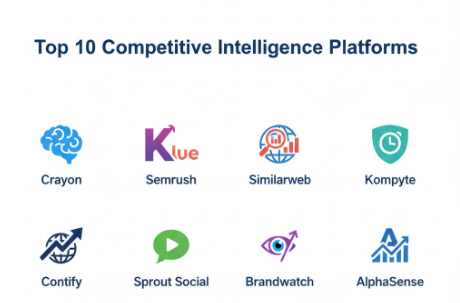
Top 10 Competitive Intelligence Platforms Tools
1 — Crayon
Crayon is a high-powered platform that focuses on “software-driven” intelligence. It is designed to track thousands of different sources across the web to find every single digital footprint left by your competitors. It is built for companies that want a total view of the market without having to lift a finger. The tool uses artificial intelligence to filter through the mountain of data and only show you the things that actually matter for your business strategy.
- Key features:
- Automated tracking of over 100 different types of data (prices, news, reviews).
- AI-powered “Signal” filtering to remove junk information.
- Customizable dashboards for different teams (Sales, Marketing, Product).
- Integration with Slack and Microsoft Teams for instant alerts.
- Built-in battlecards that update automatically when data changes.
- Archiving of competitor websites so you can see how they looked years ago.
- Pros:
- It covers an incredible range of sources, including hidden pages on websites.
- Very good at turning messy data into simple, actionable insights.
- Cons:
- The platform can be quite expensive for smaller companies.
- It takes some time to set up the filters correctly so you don’t get too many alerts.
- Security & compliance: Fully GDPR compliant and offers SSO (Single Sign-On) for secure team access.
- Support & community: Offers a dedicated customer success manager and a wide range of training videos.
2 — Klue
Klue is a platform that is famous for its focus on “Sales Enablement.” This means it is built specifically to help sales teams win more deals against competitors. It takes information from the web and combines it with internal knowledge from your own employees to create very powerful “battlecards.” It is designed to be very easy for salespeople to use while they are on a phone call with a potential customer, giving them the exact words they need to win the argument.
- Key features:
- Centralized hub for both public and internal competitive data.
- Interactive battlecards that can be accessed inside Salesforce or email.
- “News feed” style updates that keep everyone in the company informed.
- Browser extension that lets you save information while you browse.
- Ability to track win/loss data to see why you are losing to certain rivals.
- Automated alerts when a competitor changes their pricing or messaging.
- Pros:
- The best tool for helping sales teams deal with tough competition.
- Very easy to organize and share information across a large company.
- Cons:
- Not as strong for “deep” SEO or technical marketing research.
- Requires a lot of internal team participation to keep the data fresh.
- Security & compliance: SOC 2 Type 2 certified and follows strict data privacy standards.
- Support & community: Very active user community and excellent onboarding for new companies.
3 — Semrush
Semrush is a well-known tool that focuses almost entirely on the digital side of competition. It is the gold standard for seeing how your rivals are performing on Google. It tells you exactly which words they are paying for in ads and which blog posts are getting them the most traffic. It is designed for marketing teams who want to “steal” the audience of their competitors by outperforming them in search engine results and social media.
- Key features:
- Deep analysis of competitor keywords and SEO strategies.
- Tracking of rival ad spend and specific ad copy they are using.
- Social media benchmarking to see how fast rivals are growing.
- “Market Explorer” to see your share of the market compared to others.
- Backlink tracking to see which websites are talking about your competitors.
- Audit tools to see how your website compares to a rival’s site.
- Pros:
- The most powerful tool for search engine and digital marketing research.
- Very easy to start using immediately with almost no setup required.
- Cons:
- It does not track “offline” things like job postings or news articles well.
- The price can go up quickly if you need to add many team members.
- Security & compliance: Standard web encryption and full compliance with international privacy laws.
- Support & community: Massive library of free courses, a huge community, and 24/7 support.
4 — Similarweb
Similarweb is a platform that gives you a “peek” into the traffic of any website on the internet. It is designed for businesses that want to know exactly how many people are visiting their competitors and where those people are coming from. It acts like a “Google Analytics” for websites you don’t own. It is perfect for seeing if a competitor’s new marketing campaign is actually working or if their traffic is starting to drop.
- Key features:
- Real-time traffic estimates for any website or mobile app.
- Analysis of where traffic comes from (Search, Social, Ads, Direct).
- Benchmarking tools to see how you rank in your specific industry.
- Keyword research based on what is actually sending traffic to rivals.
- Geography data to see which countries a competitor is strongest in.
- Conversion rate estimates to see how many visitors are actually buying.
- Pros:
- Provides incredibly accurate traffic data that is hard to find elsewhere.
- Very helpful for understanding the “digital health” of a competitor.
- Cons:
- The data for very small websites can sometimes be less accurate.
- It is a very premium tool with a high price tag for the full version.
- Security & compliance: Follows high security protocols and is transparent about how they collect data.
- Support & community: Offers professional consulting services and a very detailed help center.
5 — Kompyte
Kompyte is an automated platform that focuses on “real-time” updates. It is designed to act like a 24/7 surveillance camera for your competitors’ websites. Whenever a rival makes a change—no matter how small—Kompyte captures it and sends you a report. It is great for fast-moving industries where prices and features change every few days. The tool is built to be simple so that any team can start using it without needing a week of training.
- Key features:
- Real-time tracking of website changes, social media, and ads.
- Automated battlecards that update as soon as a change is detected.
- Competitor benchmarking to see who is moving the fastest.
- “Win/Loss” analysis to help sales teams learn from every deal.
- Repository of competitor files (PDFs, whitepapers, case studies).
- Simple “if-then” rules to set up custom alerts.
- Pros:
- Excellent at catching tiny changes that other tools might miss.
- The interface is very modern and easy to navigate for beginners.
- Cons:
- Some users find that it sends too many alerts if not set up carefully.
- The reporting features are not as deep as enterprise tools like Crayon.
- Security & compliance: Fully GDPR compliant and uses secure cloud storage for all data.
- Support & community: Responsive customer support and good onboarding materials.
6 — Contify
Contify is an enterprise-grade intelligence platform that focuses on “market signals.” It is designed for big companies that need to follow not just competitors, but entire industries and supply chains. It is particularly good at searching through non-English websites and local news from all over the world. It is a “heavy-duty” tool for researchers and analysts who need to provide very detailed reports to company executives about global market trends.
- Key features:
- Tracking of thousands of news sources, regulatory sites, and social media.
- Multilingual support to track competitors in different countries.
- Custom “newsletters” that can be sent automatically to your team.
- AI-powered deduplication so you don’t see the same story twice.
- API access for companies that want to put the data into their own tools.
- Strategic dashboards that show long-term industry shifts.
- Pros:
- The best choice for global companies with an international focus.
- Very strong at finding “business” news rather than just “marketing” data.
- Cons:
- It is a complex system that requires a dedicated person to manage it.
- Not designed for small, quick tasks like simple keyword research.
- Security & compliance: ISO 27001 certified and provides very high-level data security.
- Support & community: Offers 24/7 technical support and dedicated training for large teams.
7 — Sprout Social
Sprout Social is primarily a social media management tool, but it has very powerful “Competitive Listening” features built-in. It is designed for social media managers who want to see how their brand’s performance compares to their rivals on platforms like Instagram, Twitter, and LinkedIn. It allows you to see the “share of voice” in your industry, which means you can see how many people are talking about you versus your competitors.
- Key features:
- Competitive benchmarking for social follower growth and engagement.
- Listening tools to see what people say about your rivals’ products.
- Sentiment analysis to see if people are happy or angry with your competitors.
- Comparison reports that show your “share of voice” in the market.
- Tracking of the most popular hashtags used by your rivals.
- Integration with major social platforms for real-time monitoring.
- Pros:
- The best tool for understanding the “social” side of competition.
- Very easy to create beautiful reports to show your boss.
- Cons:
- It does not track website changes or SEO data.
- You have to pay for a higher-tier plan to get the best competitive features.
- Security & compliance: Follows standard social media API security and privacy rules.
- Support & community: Incredible user community and a massive library of social media tips.
8 — Rival IQ
Rival IQ is a specialized tool that focuses on “Social Media Analytics.” Unlike Sprout Social, which manages your posts, Rival IQ is purely for research. It allows you to “spy” on the social media performance of any company. It is designed for digital marketers who want to know exactly which photos and videos are getting the most likes for their competitors. It helps you find the “formula” for success on social media so you can copy what works and skip what doesn’t.
- Key features:
- Head-to-head comparisons of social media engagement.
- Alerts when a competitor has a “breakout” post that goes viral.
- Automated audits of your social media performance versus rivals.
- Tracking of “hidden” social data like Facebook ad history.
- Tagging systems to organize competitors into different groups.
- Clean, simple reports that can be exported as PowerPoint slides.
- Pros:
- Very focused and easy to use if you only care about social media.
- The “Breakout Post” alerts are incredibly helpful for staying current.
- Cons:
- It has a very narrow focus and won’t help with price or product tracking.
- Can feel expensive if you are already paying for other marketing tools.
- Security & compliance: Uses secure data connections and follows all platform privacy laws.
- Support & community: Friendly customer support and a helpful blog with social media data.
9 — Brandwatch
Brandwatch is a very large platform that focuses on “Consumer Intelligence.” It is designed to listen to the entire internet to see what people are saying about brands and products. For competitive intelligence, it is powerful because it tells you exactly what customers wish your competitors’ products had. It helps you find the gaps in the market by listening to the complaints and praises of real people on forums, blogs, and social media.
- Key features:
- Access to an archive of over 1.4 trillion online conversations.
- AI-powered image recognition to see where rival logos appear.
- Real-time alerts for brand mentions and market trends.
- Deep demographic data to see who is buying from your competitors.
- Sentiment tracking to see how the public mood changes over time.
- Customizable reports for large global marketing teams.
- Pros:
- The most powerful tool for “listening” to the voice of the customer.
- Great for finding new trends before they become mainstream.
- Cons:
- It is a very expensive and complex tool for enterprise users.
- Takes a long time to learn how to set up the searches correctly.
- Security & compliance: High-level security and fully compliant with all global data laws.
- Support & community: Offers expert consulting and world-class customer support.
10 — AlphaSense
AlphaSense is a platform built for “Financial and Market Intelligence.” It is quite different from the other tools because it focuses on high-level business data like earnings reports, expert calls, and broker research. It is designed for finance teams, investors, and company leaders who need to understand the “money” side of competition. It helps you see if a rival is in financial trouble or if they are planning a big merger or acquisition.
- Key features:
- AI-powered search across millions of business and financial documents.
- Tracking of “Earnings Calls” to hear what rival CEOs are saying.
- Access to expert interviews about specific companies and industries.
- Real-time alerts for SEC filings and other legal documents.
- “Sentiment” analysis of financial reports to see if a company is nervous.
- Integration with internal research tools for large banks and firms.
- Pros:
- The best tool for high-level business and financial research.
- Finds information that is often hidden in thousands of pages of text.
- Cons:
- Not useful for day-to-day marketing or social media tracking.
- The interface is designed for professional analysts and can be difficult.
- Security & compliance: Bank-level security and very strict data privacy certifications.
- Support & community: Provides 24/7 support and dedicated research assistants for clients.
Comparison Table
| Tool Name | Best For | Platform(s) Supported | Standout Feature | Rating |
| Crayon | Full Automation | Web, Cloud | Website Archiving | N/A |
| Klue | Sales Enablement | Web, Mobile | Sales Battlecards | N/A |
| Semrush | SEO & Search Ads | Web, Browser | Keyword Tracking | N/A |
| Similarweb | Traffic Analysis | Web, API | Digital Market Share | N/A |
| Kompyte | Real-Time Updates | Web, Cloud | Instant Web Tracking | N/A |
| Contify | Global Market News | Web, API | Multilingual News | N/A |
| Sprout Social | Social Listening | Web, Mobile | Share of Voice | N/A |
| Rival IQ | Social Benchmarking | Web | Breakout Post Alerts | N/A |
| Brandwatch | Consumer Insights | Web, Cloud | Conversation Archiving | N/A |
| AlphaSense | Financial Research | Web, Mobile | Earnings Call Search | N/A |
Evaluation & Scoring of Competitive Intelligence Platforms
The table below shows how these platforms are scored based on the factors that matter most to businesses.
| Evaluation Category | Weight | Key Considerations |
| Core Features | 25% | Automation, data variety, and signal filtering. |
| Ease of Use | 15% | How simple the dashboard is for a non-expert. |
| Integrations | 15% | Connecting to Slack, Salesforce, and other apps. |
| Security & Compliance | 10% | Data encryption, GDPR, and enterprise safety. |
| Performance | 10% | Speed of data updates and reliable uptime. |
| Support & Community | 10% | Help articles, training, and response times. |
| Price / Value | 15% | Total cost versus the time and money saved. |
Which Competitive Intelligence Platform Is Right for You?
Solo users vs SMB vs mid-market vs enterprise
If you are working alone or in a very small team, you should start with Semrush or Rival IQ. These tools are easy to set up and give you immediate results for your website and social media. Small to medium businesses (SMBs) will find Kompyte or Klue to be very helpful for keeping their sales and marketing teams on the same page. If you are a mid-market company growing fast, Crayon or Similarweb provide the level of detail you need to win. Large global enterprises that need to worry about the whole world should choose Contify, Brandwatch, or AlphaSense to stay safe and informed.
Budget-conscious vs premium solutions
For those with a smaller budget, Semrush is the best choice because you get a lot of data for one price. Rival IQ is also quite affordable for social media tracking. However, if you have a larger budget and want to save as much time as possible, premium solutions like Crayon or Klue are worth the investment. These tools do the “thinking” for you, which means your expensive employees don’t have to waste time doing manual research.
Feature depth vs ease of use
There is always a balance between having many features and being easy to master. Kompyte and Rival IQ are very easy to use, and you can learn them in an hour. On the other hand, tools like Brandwatch or AlphaSense have incredible depth and can do things other tools can’t, but they require a lot of training to use correctly. You should think about whether you have a dedicated person who can learn the software or if you need something that “just works” for everyone.
Integration and scalability needs
Before you pick a tool, check if it works with your existing software. If your sales team lives in Salesforce, you should pick a tool like Klue that puts the data right where they work. If you plan to grow from 50 employees to 500 in the next few years, make sure the tool can grow with you. Crayon and Contify are very good at scaling as your company gets bigger and your needs become more complex.
Security and compliance requirements
If your company is in a highly regulated industry like healthcare or banking, security is your number one priority. You should only look at tools with SOC 2 or ISO certifications. AlphaSense and Klue are leaders in this area. If you are a standard marketing company, the basic GDPR compliance offered by almost all these tools will be enough to keep you and your competitors’ data safe.
Frequently Asked Questions (FAQs)
1. What is a competitive intelligence platform?
It is a software tool that automatically gathers and analyzes information about your competitors’ websites, prices, products, and marketing moves.
2. Is it ethical to use these platforms?
Yes. These tools only collect information that is publicly available on the internet. They are like a professional research assistant, not a spy.
3. Do these tools work in real-time?
Many of them, like Kompyte, work in near real-time, sending you an alert the same day a competitor makes a change.
4. How much do these platforms cost?
The price varies a lot. Some marketing tools start at around $100 a month, while enterprise platforms like Crayon can cost thousands of dollars a year.
5. Can I track social media and websites in one tool?
Yes, platforms like Crayon and Kompyte track both, but specialized tools like Rival IQ are often better if you only care about social media.
6. Do I need a developer to set these up?
Most of these tools do not require any coding. You just enter your competitors’ website names and the tool starts working.
7. Can these tools help my sales team?
Absolutely. Tools like Klue and Crayon create “battlecards” that give sales teams the exact points they need to win against a rival.
8. How do I know the data is accurate?
Top-tier tools use AI and human verification to ensure the data is correct, but you should always pick a well-known brand to be safe.
9. Can I track international competitors?
Yes, tools like Contify and Similarweb are designed to track companies all over the world in many different languages.
10. What is the biggest mistake people make with these tools?
The biggest mistake is collecting too much information and not taking action. It is better to track a few things carefully than everything poorly.
Conclusion
Choosing the right competitive intelligence platform is a major step in making your business more professional and harder to beat. These tools act as a powerful extension of your team, watching the market while you focus on building great products and serving your customers. By automating the task of research, you ensure that you are never surprised by a rival’s move. It is a strategic move that helps you spend your marketing money more wisely, win more sales, and stay ahead of changes in your industry before they happen.
It is important to remember that there is no single “perfect” tool for every company. The best choice depends on what you are trying to achieve—whether it is winning more sales deals, improving your SEO, or understanding global market trends. You should look for a platform that fits your current size but also has the power to grow with you. Take your time to test the tools, look at the data they provide, and pick the one that feels like a natural fit for your team. When you have the right intelligence, your business will feel much more stable and ready for the future.