Introduction
Digital coupon management tools are specialized platforms that allow businesses to create, distribute, and track digital discounts and promotional offers. In the past, coupons were simple pieces of paper found in a Sunday newspaper. Today, they are sophisticated bits of code that live in mobile apps, SMS messages, and digital wallets. These tools act as the brain of your promotional strategy, making sure that every discount you give away is secure, trackable, and reaches the right person. They replace the old “one-size-fits-all” approach with a smart system that can offer a specific discount to a first-time shopper while giving a different reward to a loyal customer.
Using these tools is important because they protect your profit margins. Without a proper management system, promo codes can “leak” to coupon-sharing websites, leading to thousands of unauthorized redemptions that can cost a business a fortune. Modern tools prevent this by using “single-use” codes that expire once they are redeemed. Real-world use cases include abandoned cart reminders, birthday rewards, and location-based offers that pop up on a customer’s phone when they walk near a physical store. When choosing a tool, you should look for its ability to integrate with your current point-of-sale (POS) system, the strength of its security features, and how well it handles high volumes of traffic during big sales events.
Best for:
Digital coupon management tools are most beneficial for e-commerce marketing teams, retail operations managers, and growth hackers at mid-to-large-sized companies. They are ideal for industries like fashion retail, quick-service restaurants, travel, and consumer electronics where promotions are a daily part of the business. Any organization that wants to move away from generic, “leaky” codes toward personalized, secure incentives will find these platforms essential.
Not ideal for:
These tools may not be necessary for very small local businesses that only run a few promotions a year. If you only have ten regular customers and a simple “10% off” sign in your window, a complex enterprise system would be an unnecessary expense. They are also not a replacement for a full CRM or a complete accounting package, as their focus is specifically on the logic and lifecycle of promotional offers.
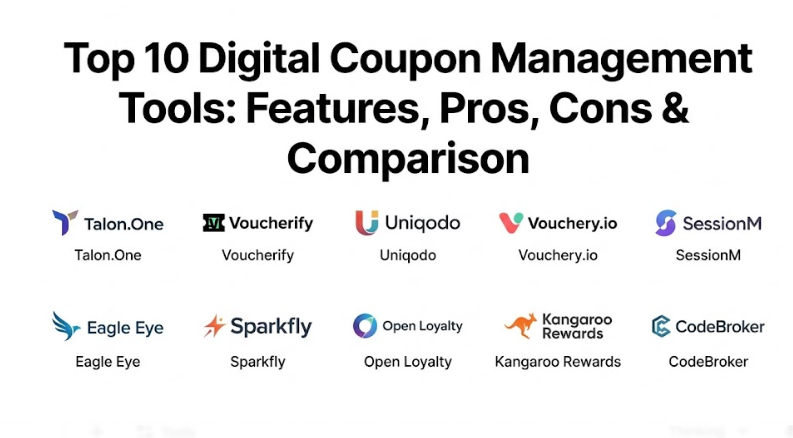
Top 10 Digital Coupon Management Tools
1 — Talon.One
Talon.One is a powerful, enterprise-grade promotion engine designed to handle the most complex rule-based logic imaginable. It doesn’t just manage coupons; it allows you to build sophisticated “decision trees” for every discount. For example, you can tell the system to give a 20% discount only if it’s raining in New York and the customer has spent over $100 in the last month. It is built as a “headless” solution, meaning it lives in the background and talks to your website or app via an API, giving developers total freedom to design the customer experience.
- Key features:
- A visual rule builder that allows non-developers to create complex promotion logic.
- Support for multi-currency and multi-market campaigns for global brands.
- Geofencing capabilities to trigger offers based on a customer’s physical location.
- Advanced A/B testing to see which types of discounts perform the best.
- Real-time validation to stop fraud before a customer hits the “buy” button.
- Deep integration with loyalty programs and referral systems.
- Sophisticated analytics that track the exact ROI of every campaign.
- Pros:
- It offers unparalleled flexibility for large companies with creative marketing ideas.
- The system is incredibly scalable and can handle millions of transactions during peak times.
- Cons:
- There is a steep learning curve for the rule builder, which can feel overwhelming at first.
- The cost is high, making it more suitable for large enterprises rather than startups.
- Security & compliance: SOC 2 compliant; fully GDPR compliant; uses end-to-end encryption for all data transmissions; features robust audit logs.
- Support & community: High-quality documentation; dedicated account managers for enterprise tiers; 24/7 technical support availability.
2 — Voucherify
Voucherify is an API-first promotion platform that is widely loved by developer teams for its clean structure and ease of integration. It provides a “Lego-like” set of building blocks for coupons, gift cards, and loyalty programs. What makes it special is how it balances power for developers with a simple dashboard for marketing teams. It is designed for businesses that want to launch their first professional promotion system quickly but also need the room to grow into more advanced features later on.
- Key features:
- Simple API and SDKs that allow for fast integration with web and mobile apps.
- A user-friendly “wizard” that guides you through the process of creating a campaign.
- Support for universal codes, personalized one-to-one codes, and contextual rewards.
- Real-time stacking rules that prevent customers from using too many discounts at once.
- Built-in analytics that show you exactly how many codes were distributed versus redeemed.
- Multilingual and multi-currency support for international operations.
- A “Demo Store” where you can test your campaigns before they go live to the public.
- Pros:
- It is very developer-friendly, with some of the best technical documentation in the industry.
- The pricing model is transparent and scales as your business grows.
- Cons:
- Some of the most advanced targeting features are restricted to the higher-priced tiers.
- The user interface has recently changed, and some long-time users find the new design a bit complex.
- Security & compliance: ISO 27001 certified; GDPR and CCPA compliant; supports 2FA (Two-Factor Authentication) for admin access.
- Support & community: Responsive live chat support; extensive video tutorials; active developer community on social platforms.
3 — Uniqodo
Uniqodo is a specialist in “closed-loop” promotion management, which means its main focus is on preventing code leakage and margin erosion. It is the tool you use when you are tired of seeing your exclusive “influencer” codes appearing on public coupon sites. Uniqodo excels at creating unique, single-use codes and controlling exactly where and how they are distributed. They take a “SaaS-plus-consultancy” approach, meaning they don’t just give you the software; they also help you design a strategy to protect your brand’s value.
- Key features:
- Advanced single-use code generation that is impossible for bots to guess.
- Sophisticated “margin protection” logic that ensures you never lose money on a deal.
- Tools to manage affiliate and partnership promotions without losing control of the codes.
- Automated distribution across email, SMS, and partner websites.
- Real-time monitoring of “leakage” sites to see if your codes have been shared publicly.
- Deep integration with existing e-commerce checkout systems.
- Detailed reporting on acquisition, engagement, and conversion metrics.
- Pros:
- It is arguably the best tool for protecting against coupon abuse and fraud.
- The team provides expert advice on how to structure promotions for maximum impact.
- Cons:
- It is more specialized than “all-in-one” platforms, so it might lack some generic loyalty features.
- The platform is designed more for medium-to-large brands rather than small shops.
- Security & compliance: GDPR compliant; features high-level encryption for all unique code databases; offers secure access controls for team members.
- Support & community: Dedicated account success managers; expert-led onboarding; high-quality technical support.
4 — Vouchery.io
Vouchery.io is built around the idea that promotions should be automated and driven by data. It uses AI and machine learning to help e-commerce teams figure out which customers should get which discount. It is particularly strong at “Next Best Offer” targeting, which predicts the exact incentive needed to get a customer to make their next purchase. The platform is designed to be lightweight and fast, making it a great choice for growth teams that want to move quickly without building complex internal rule engines.
- Key features:
- AI-driven prediction models that help you optimize your promotional budget.
- Real-time abuse scoring that flags suspicious redemption attempts instantly.
- Fast campaign setup with a “no-code” interface for marketing teams.
- Integration with popular customer data platforms (CDPs) like Segment and Braze.
- Support for multi-channel distribution, including web, mobile, and social media.
- Automated deactivation of campaigns once a specific budget or limit is reached.
- Analytics that focus on “incremental lift” to see if your coupons are actually driving new sales.
- Pros:
- The AI features help automate the decision-making process for busy marketing teams.
- It is very easy to set up and requires minimal technical support from your engineering team.
- Cons:
- The interface can feel a bit basic for users who are used to high-end enterprise dashboards.
- Some of the predictive models require a large amount of historical data to work accurately.
- Security & compliance: GDPR compliant; uses secure API keys and encryption; data is hosted in highly secure cloud regions.
- Support & community: Friendly chat and email support; clear knowledge base; tiered support levels based on subscription plan.
5 — SessionM (by Mastercard)
SessionM is an enterprise-scale platform that combines loyalty programs, customer data, and promotion orchestration into one unified hub. Since it is part of the Mastercard family, it has deep roots in financial data and payment security. It is built for massive organizations—like global retail chains or hospitality groups—that need to connect their online store with thousands of physical POS systems. It is less of a “coupon tool” and more of a “customer engagement engine” that uses coupons as a key part of the journey.
- Key features:
- Real-time customer profiles that merge data from every touchpoint.
- Deep integration with hundreds of different POS and payment systems globally.
- Event-driven offer activation (e.g., a coupon is sent the moment a customer enters a store).
- Integrated loyalty points and tier management tied directly to coupon logic.
- Advanced segmentation that updates in real-time as a customer’s behavior changes.
- Professional-grade analytics and business intelligence (BI) tools.
- High-volume campaign management that can handle millions of active users.
- Pros:
- It is incredibly robust and reliable, which is why it is used by major global brands.
- The connection to payment data provides insights that other platforms simply cannot match.
- Cons:
- It is a very large and complex system that requires a significant investment in time and money.
- The setup process is a major project that often involves consultants and engineers.
- Security & compliance: Bank-level security standards; SOC 2 and PCI DSS compliant; strict global data privacy adherence.
- Support & community: Enterprise-tier support; dedicated technical teams; extensive professional training and certification.
6 — Eagle Eye
Eagle Eye is a cloud-native platform specifically designed for the retail and hospitality industries. Their AIR platform acts as a bridge that allows brands to activate their digital marketing efforts at the physical point of sale. It is a world leader in “omnichannel” promotions, meaning it ensures that a coupon sent via email can be scanned at a grocery store or restaurant checkout without any errors. It focuses on the real-time execution of offers, making sure that when a customer presents a code, it is validated and “retired” in less than a second.
- Key features:
- Real-time integration with legacy and modern POS systems.
- Support for QR codes, barcodes, and digital wallet passes.
- Intelligent checkout features that automatically apply the best offer for the customer.
- AI-enhanced personalization that suggests individualized offers at the right time.
- Comprehensive gifting and “top-up” features for prepaid and digital accounts.
- Detailed first-party data collection from every transaction.
- Automated financial reconciliation for multi-vendor promotion campaigns.
- Pros:
- It is the gold standard for connecting digital marketing to physical store checkouts.
- The system is incredibly fast, ensuring that checkout lines never slow down due to a coupon.
- Cons:
- Its focus is heavily on retail and hospitality, so it might not be the best fit for purely digital SaaS businesses.
- The complexity of POS integration means you will need technical help to get started.
- Security & compliance: ISO 27001 compliant; PCI compliant for payment handling; secure cloud-native architecture.
- Support & community: Live support teams; professional implementation services; regular webinars for retail marketing leaders.
7 — Sparkfly
Sparkfly is a technology-driven platform that specializes in offer management and POS modernization. It is particularly popular in the quick-service restaurant (QSR) and casual dining industries. Sparkfly allows marketers to create and launch personalized digital campaigns that bridge the gap between social media, mobile apps, and the restaurant’s cash register. Its main goal is to give marketers “real-time effectiveness” so they can see exactly how a social media ad is driving actual burger sales in a specific store.
- Key features:
- Real-time sales attribution that tracks a customer from an ad to a purchase.
- Integration with major restaurant POS systems like Toast, NCR, and Brink.
- Support for mobile wallet passes (Apple Wallet and Google Pay).
- Automated “reward” triggers based on real-time transaction data.
- A lightweight API that can be added to existing mobile apps easily.
- Detailed dashboards that show channel performance and customer purchasing patterns.
- Tools for managing both digital and physical (print) coupons in one place.
- Pros:
- It is excellent at modernizing older retail systems without a complete overhaul.
- The data-driven insights help businesses make smarter choices about their media spend.
- Cons:
- It is a niche tool focused on the “offline-online” gap, so it may lack some pure e-commerce features.
- Customer support is generally focused on business hours for smaller tiers.
- Security & compliance: Varies by integration; uses secure tokenization for transactions; follows industry-standard data protection rules.
- Support & community: Offers training documentation and webinars; live training available for enterprise clients.
8 — Open Loyalty
Open Loyalty is a highly flexible, API-first engine that unifies coupons, loyalty programs, and gamification into one single layer. It is built as a “headless” platform, meaning you can wire its logic into any existing commerce stack, mobile app, or POS system. It earns its position through architectural depth; it doesn’t just “do” coupons, it lets you build a whole ecosystem of points, tiers, and challenges that are all connected to your promotional offers. This makes it a great choice for brands that see coupons as a long-term engagement tool rather than a one-time trick.
- Key features:
- A unified rule engine that handles loyalty points and coupon logic at the same time.
- Headless and API-first architecture for total design freedom.
- Multi-tenant setup that is perfect for companies with multiple brands or markets.
- Gamification mechanics like “streaks,” milestones, and progress bars.
- Support for bulk coupon generation and personalized one-to-one codes.
- Real-time webhooks that allow the platform to react to events across your whole stack.
- Customer “cockpits” where users can see all their available rewards in one place.
- Pros:
- It is incredibly flexible and can be customized to fit almost any business model.
- The unified approach simplifies management by having everything under one roof.
- Cons:
- The “headless” nature means you will definitely need developers to build the front-end experience.
- It can be more complex to set up than a simple “plug-and-play” app.
- Security & compliance: SOC 2 compliant; features enterprise-grade security and reliability; fully GDPR compliant.
- Support & community: High-quality developer documentation; responsive technical support; active online community for knowledge sharing.
9 — Kangaroo Rewards
Kangaroo Rewards is a user-friendly platform that is designed specifically for small and mid-sized businesses (SMBs). It provides a ready-to-use solution that includes a mobile app for your customers, a website portal, and a dashboard for the business owner. It is perfect for local shops, cafes, and boutiques that want to launch a professional coupon and loyalty program without hiring a team of engineers. It focuses on the “bang for the budget” approach, offering a lot of pre-built features for a monthly fee that a small business can actually afford.
- Key features:
- A branded mobile app for your customers to store and use their coupons.
- Simple “point-and-click” campaign builder for creating discounts and deals.
- Integration with popular small-business POS systems like Shopify and Lightspeed.
- Automated emails and push notifications to keep customers coming back.
- Receipt scanning feature that allows customers to earn rewards even if they forgot their app.
- Tools for running referral programs and social media sharing contests.
- Simple reporting that tells you which customers are your most valuable.
- Pros:
- It is very affordable and designed for the needs of a small-business owner.
- The setup is fast, and you can be live with a professional program in a few days.
- Cons:
- It lacks the deep API customization found in enterprise platforms.
- The design of the consumer app is standardized and cannot be fully customized.
- Security & compliance: PCI compliant; standard data encryption; follows basic data privacy rules.
- Support & community: Friendly phone and email support; clear “getting started” guides; regular webinars.
10 — CodeBroker
CodeBroker is a long-standing leader in the world of mobile coupon management, with a specific focus on omnichannel retail. It is designed to ensure that a coupon’s journey from “click to cart” is secure and measurable. CodeBroker is particularly strong at “single-use” mobile coupons and SMS marketing. They provide a “MyOffers” digital wallet that gives your customers a single place to find all their latest deals on their phones. It is a high-security tool that ensures your offers never go viral or get reused by people who weren’t meant to have them.
- Key features:
- Sophisticated single-use digital coupon generation and validation.
- Enterprise-class SMS marketing software with built-in compliance tools.
- The “MyOffers” digital wallet for storing and organizing coupons.
- Real-time POS integration for secure in-store redemptions.
- Automated “rolling” expiration dates that adapt to when a customer receives a code.
- Advanced fraud prevention that blocks screenshots and bot-driven redemptions.
- Detailed individual-level tracking for deep insights into customer behavior.
- Pros:
- It is one of the most secure platforms for preventing coupon fraud and “viral” leaks.
- The focus on mobile-first distribution (SMS and Wallets) is excellent for modern retail.
- Cons:
- The interface can feel a bit technical and dated for some marketing users.
- It requires meaningful integration with your POS system to reach its full potential.
- Security & compliance: High-level security; PCI compliant; features robust audit logs; secure data storage.
- Support & community: Dedicated campaign managers; expert-led strategy planning; responsive help center.
Comparison Table
| Tool Name | Best For | Platform(s) Supported | Standout Feature | Rating |
| Talon.One | Complex Enterprise Rules | Headless / API | Visual Rule Builder | 4.8 / 5 |
| Voucherify | Developer-Led Growth | API-First / Web | Clean API & Docs | 4.7 / 5 |
| Uniqodo | Margin Protection | SaaS / Cloud | Anti-Leakage Tech | 4.8 / 5 |
| Vouchery.io | AI-Driven E-commerce | Web / Cloud | Predictive Targeting | 4.5 / 5 |
| SessionM | Omnichannel Loyalty | Cloud / Mobile | Mastercard Data Sync | 4.5 / 5 |
| Eagle Eye | Retail & Hospitality | Cloud / POS | AIR Execution Platform | 4.7 / 5 |
| Sparkfly | POS Modernization | Cloud / POS | Real-time Attribution | 4.6 / 5 |
| Open Loyalty | Unified Loyalty Stack | Headless / API | Loyalty-Coupon Hybrid | 4.8 / 5 |
| Kangaroo | Small Local Businesses | App / Web | Pre-built Mobile App | 4.5 / 5 |
| CodeBroker | High-Security Retail | SMS / Wallet | Single-Use Security | 4.6 / 5 |
Evaluation & Scoring of Digital Coupon Management Tools
To help you compare these platforms fairly, we have evaluated them using a weighted scoring model based on the factors that drive long-term promotional success.
| Evaluation Category | Weight | What We Looked For |
| Core Features | 25% | Single-use security, rule granularity, and rule logic. |
| Ease of Use | 15% | Dashboard intuitiveness and the campaign setup wizard. |
| Integrations | 15% | Depth of API/SDKs and connection to major POS/e-commerce. |
| Security & Compliance | 10% | SOC 2, GDPR, PCI, and fraud prevention mechanisms. |
| Performance | 10% | Latency of redemptions and system uptime reliability. |
| Support & Community | 10% | Quality of documentation and speed of technical response. |
| Price / Value | 15% | Transparency of fees and alignment with business scale. |
Which Digital Coupon Management Tool Is Right for You?
Choosing a tool is all about matching the platform to your technical “appetite” and your business goals.
- Solo Users & Small Startups: If you are a small team with a limited budget, look for tools that offer a “freemium” model or a low monthly starting price. Voucherify or Kangaroo Rewards are excellent starting points. They allow you to launch your first campaigns in days without needing a team of engineers to manage them.
- Mid-Market Growth Teams: If your business is growing fast and you need more automation, focus on Vouchery.io or Uniqodo. These tools help you protect your profit margins by using AI and secure distribution, ensuring that every discount is working toward your growth rather than just being a “giveaway.”
- Enterprise Retailers: For large organizations that have thousands of employees and complex systems, you need the reliability and power of SessionM, Eagle Eye, or Talon.One. These platforms are designed to handle the massive volumes of an international brand and can connect your online world to your physical stores perfectly.
- Budget-Conscious vs. Premium: If you want to keep costs low, look for “usage-based” pricing where you only pay for the number of API calls or redemptions you use. If you have a larger budget and need high-level security and strategy help, a premium platform like CodeBroker or Uniqodo is worth the investment for the peace of mind they provide.
- Integration Needs: Always check if the tool “talks” to your current store. If you use Shopify, Kangaroo or Voucherify have easy connectors. If you are a high-end hospitality group with a specialized POS, you should look at Sparkfly or Eagle Eye for their deep retail expertise.
Frequently Asked Questions (FAQs)
1. What exactly is a digital coupon management system?
It is a piece of software that handles the entire life of a discount code—from creating a unique number and sending it to a customer, to checking if the code is valid when they try to use it and making sure it can never be used again.
2. Why should I use a management tool instead of my e-commerce platform’s built-in codes?
Basic e-commerce codes (like “SAVE10”) are generic and can be shared easily on the web, leading to fraud. A management tool creates “unique” codes for every person, preventing abuse and giving you much better data on who is actually using your offers.
3. Are these tools difficult for a non-technical person to use?
It depends on the tool. “Headless” tools like Talon.One require a developer to set up. However, “plug-and-play” platforms like Kangaroo Rewards or Voucherify have easy dashboards that a marketing manager can use without any help.
4. Can these tools prevent my codes from appearing on coupon sites?
Yes. By using “single-use” codes that only work for one specific email address or account, even if the code is shared on a public site, it will not work for anyone else.
5. How much do these tools usually cost?
Pricing varies from free for tiny businesses to thousands of dollars a month for global enterprises. Most charge based on how many “API calls” (interactions) or redemptions occur in a month.
6. Can I use digital coupons in my physical brick-and-mortar store?
Absolutely. Tools like Eagle Eye and Sparkfly are designed specifically for this. They create QR codes or barcodes that your cashier can scan at the checkout, which then validates the code in real-time.
7. Is my customer data safe in these platforms?
Reputable tools follow strict laws like GDPR and CCPA. They use high-level encryption and secure servers to make sure that your customers’ names and emails are never exposed to hackers.
8. Do these systems slow down the checkout process?
Modern enterprise systems are built to respond in less than 200 milliseconds. This means the validation happens so fast that neither the customer nor the cashier will notice any delay at all.
9. Can I track the “ROI” of my coupon campaigns?
Yes. Since every code is unique, you can see exactly which marketing campaign (like a specific email or social media post) led to the sale, allowing you to see which ads are worth your money.
10. What is a “headless” promotion engine?
A headless engine provides the “brain” (the logic and data) but doesn’t have a “head” (the visual part). This allows your team to design exactly how the coupon looks in your app while the software handles the difficult calculations in the background.
Conclusion
Finding the right digital coupon management tool is one of the smartest things a business can do to protect its profits and improve its marketing. These platforms do much more than just “give discounts”; they provide a secure foundation for building real relationships with your customers. By moving away from generic, “leaky” codes toward smart, personalized incentives, you can ensure that every promotional dollar you spend is driving real growth for your company. Whether you need a simple tool for a local shop or a massive engine for a global retail brand, there is a solution on this list that can help.
The “best” tool isn’t necessarily the one with the most features; it’s the one that fits your current team and your future goals. Always take the time to run a small “pilot” project to see how a platform feels in your daily work before making a long-term commitment. Remember that in the modern world, a coupon is a conversation with your customer. By choosing a system that makes that conversation secure, personal, and easy, you are setting your business up for long-term success.