Introduction
Affiliate payout platforms are specialized digital systems designed to help businesses send money to their marketing partners, influencers, and brand promoters. These tools act as a bridge between a company’s bank account and the various people around the world who help sell their products. Instead of a business owner having to manually send hundreds of individual bank transfers or checks, these platforms automate the entire process. They handle everything from collecting bank details and verifying identities to calculating the correct commission and making sure the money arrives in the right currency. By using these systems, businesses can focus on growing their sales while the software takes care of the difficult financial math and messy paperwork that usually comes with paying a large group of people.
These platforms are very important because they help build trust between a brand and its partners. When an affiliate knows they will be paid on time and in their local currency without hidden fees, they are much more likely to keep promoting the business. Furthermore, these tools help companies follow strict laws regarding taxes and international money transfers. Without them, a company might accidentally break a rule or fail to collect a necessary tax form, which could lead to expensive fines. By automating these tasks, a business can scale its affiliate program from just ten people to ten thousand without needing to hire a massive accounting team. This efficiency makes it possible for even small companies to compete on a global stage.
Key Real-World Use Cases
- Global Influencer Networks: Companies that work with thousands of social media creators in different countries use these tools to pay everyone in their local currencies like Euros, Pesos, or Yen.
- SaaS Referral Programs: Software companies often give a small reward to users who bring in new customers. These platforms automate those small “thank you” payments without any manual work.
- Digital Marketplaces: Websites where many people sell goods or services use payout tools to split the revenue and send the correct portion to each seller.
- Gaming and App Rewards: Mobile apps that pay users for reaching certain milestones use these systems to send instant rewards to user wallets or bank accounts.
What to Look For (Evaluation Criteria)
When you are looking for a platform to pay your affiliates, you should check how many countries and currencies they support. A good tool should offer many ways to pay, such as bank transfers, PayPal, or even prepaid cards. You also need to look for automated tax collection, which means the tool asks your partners for their tax forms before they get paid. Ease of use is also vital; the dashboard should be simple enough for a marketing manager to use without needing a degree in finance. Finally, consider the fees. Some tools charge a flat monthly fee, while others take a small percentage of every payment you send.
Best for: These tools are perfect for marketing managers, finance teams, and business owners who run growing affiliate or referral programs. They are especially helpful for companies that have partners in many different countries or those who want to stop spending hours every month on manual spreadsheets and bank logins. Larger enterprises with complex tax requirements will find these platforms essential for staying organized.
Not ideal for: A business that only has one or two local affiliates might find these platforms too expensive or complicated. If you are just starting and only need to send a couple of payments within your own country, a simple bank transfer or a personal PayPal account might be better. Also, companies that do not plan to grow their partner network significantly may not see enough value to justify the cost of a professional payout platform.
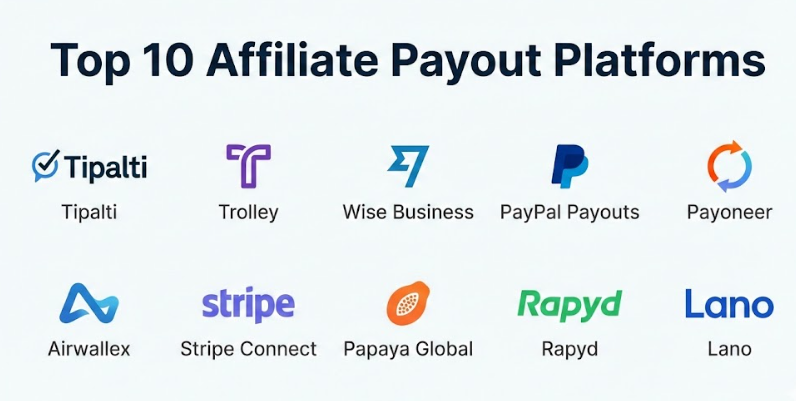
Top 10 Affiliate Payout Platforms Tools
1 — Tipalti
Tipalti is a very powerful system designed for businesses that need to send a lot of payments to people all over the world. It is built to handle the entire journey of a payment, from the moment a partner signs up to the moment they get their money. The platform is especially famous for its ability to handle complex tax rules and global compliance without making the user do any extra work. It is designed to grow with a company, making it a favorite for big brands and fast-growing startups that don’t want to worry about their payment systems breaking as they get bigger.
- Key features:
- Mass payments to over 190 countries in local currencies.
- Automated tax form collection for W-9 and W-8 forms.
- Self-service portal where affiliates can manage their own bank details.
- Built-in fraud detection to prevent fake accounts from getting paid.
- Integrates directly with popular accounting software like QuickBooks.
- Support for many payment methods including ACH, Wire, and PayPal.
- Pros:
- It reduces the manual work for finance teams by up to eighty percent.
- Very strong focus on following international laws and tax rules.
- Cons:
- The setup process can take a long time because it is so detailed.
- It can be more expensive than simpler tools, making it better for bigger teams.
- Security & compliance: This tool follows high security standards like SOC 2 and is fully compliant with GDPR and HIPAA rules to protect user data.
- Support & community: They provide excellent documentation and a dedicated account manager for bigger clients. There is also a strong community of finance professionals who use it.
2 — Trolley
Trolley, which used to be called Payment Rails, is a platform created specifically for the “payout economy,” which includes affiliates, freelancers, and creators. It is designed to be very simple to use while still being powerful enough to send thousands of payments at once. The tool focuses heavily on the user experience for the person receiving the money, ensuring they get clear notifications and fast access to their funds. It is a great middle-ground option for companies that need more than a basic bank tool but aren’t ready for a giant enterprise system.
- Key features:
- Simple dashboard for managing thousands of global recipients.
- Real-time tracking so you can see exactly where a payment is.
- Automated tax reporting and end-of-year form generation.
- Bank account validation to prevent errors before you hit send.
- White-label emails so the payment notices look like they came from your brand.
- Easy API for developers who want to build payouts into their own apps.
- Pros:
- The interface is very clean and easy for beginners to understand.
- Fees are very competitive, especially for international transfers.
- Cons:
- Customer support can sometimes be slow for users on the cheaper plans.
- It has fewer integrations with very large enterprise accounting systems.
- Security & compliance: They use bank-level encryption and are a regulated money service business with strict AML and KYC checks.
- Support & community: They offer a helpful help center and email support. They are popular among smaller tech startups and creator platforms.
3 — Wise Business
Wise is known for having some of the lowest fees in the world for sending money across borders. Their business platform is perfect for companies that want to pay affiliates without losing a lot of money to bad exchange rates. It is a very transparent tool that shows you exactly how much every transfer costs before you confirm it. While it doesn’t have as many “automation” features for taxes as some other tools, its simplicity and low cost make it a top choice for smaller businesses and solo owners.
- Key features:
- Real mid-market exchange rates with no hidden markups.
- Batch payment tool that lets you upload a single file to pay 1,000 people.
- Multi-currency accounts to hold and manage money in different coins.
- Local bank details for many countries, making it feel like a local payment.
- Mobile app that lets you approve and send payments on the go.
- Direct integration with Xero and other accounting tools.
- Pros:
- The most honest and low-cost exchange rates in the industry.
- Very fast setup; you can start sending payments in just a few days.
- Cons:
- Does not automatically collect or manage tax forms for you.
- Lacks the advanced “approval workflows” that big companies might need.
- Security & compliance: Regulated by financial authorities in every country they operate in and uses two-factor authentication for all users.
- Support & community: Primarily online help articles and email support, which is efficient but might feel a bit impersonal for large teams.
4 — PayPal Payouts
PayPal is perhaps the most famous name in online payments, and their Payouts tool allows businesses to send money to anyone with an email address. Because almost everyone already has a PayPal account, this is often the easiest way to start paying affiliates. It is designed for speed and convenience, allowing you to send funds instantly to thousands of people at once. It is a reliable choice because your partners already know and trust the PayPal name, which makes them feel more comfortable joining your program.
- Key features:
- Instant delivery of funds to a recipient’s PayPal account.
- Global reach in over 200 markets and many different currencies.
- Simple file upload for mass payments without needing any code.
- Advanced API for businesses that want to automate payments through their site.
- Trusted brand name that reduces “payment anxiety” for new affiliates.
- Easy reconciliation with built-in reporting tools.
- Pros:
- Extremely easy for affiliates to receive and use their money.
- No need to collect complicated bank details like IBAN or SWIFT codes.
- Cons:
- The fees can be quite high, especially for international transfers.
- PayPal can sometimes hold funds or freeze accounts for security reviews.
- Security & compliance: Very high levels of fraud protection and encryption, as you would expect from a world leader in payments.
- Support & community: Large-scale enterprise support is available, though smaller businesses may find it hard to get a human on the phone quickly.
5 — Payoneer
Payoneer is a favorite for affiliate networks and freelancers who work in regions where traditional banking is difficult. It provides users with a digital wallet and a debit card that they can use to spend their earnings anywhere. For a business, Payoneer makes it easy to pay a global team because the platform handles the currency conversion and the delivery of funds. It is designed to be a “bridge” for the global economy, helping people in different parts of the world do business together more easily.
- Key features:
- Provides affiliates with a virtual bank account in multiple currencies.
- Low-cost transfers between different Payoneer accounts.
- Option for affiliates to get a physical debit card to withdraw cash.
- Integration with major affiliate platforms like Amazon and ClickBank.
- Mass payout tools for businesses to pay their entire network at once.
- Strong support for partners in emerging markets.
- Pros:
- Great for partners who don’t have a traditional bank account.
- Payments between Payoneer users are often free and very fast.
- Cons:
- The fees for withdrawing money to a local bank can be a bit high.
- The user interface can feel a bit old-fashioned compared to newer tools.
- Security & compliance: Licensed as a money transmitter in the US and Europe, with strong anti-fraud and identity verification steps.
- Support & community: Offers 24/7 support in many different languages, which is very helpful for a global audience.
6 — Airwallex
Airwallex is a modern financial platform that helps businesses manage their money globally without the high costs of a traditional bank. It is built for the digital age, offering a very fast and sleek interface for sending payouts. It is particularly good for businesses that want to open “local” bank accounts in other countries to receive and send money without expensive wire fees. It is designed to be a one-stop-shop for everything from corporate cards to affiliate payouts, making it very useful for tech-savvy teams.
- Key features:
- Create local bank accounts in minutes in over twenty currencies.
- Zero-fee international transfers when using their local payment rails.
- High-speed batch payments for global affiliate groups.
- Virtual cards that you can issue to partners for reward payments.
- Direct integration with Shopify and other e-commerce tools.
- A powerful API that makes it easy for developers to build on top of.
- Pros:
- Excellent exchange rates that are often better than big banks.
- The platform is very fast and rarely has any technical glitches.
- Cons:
- It is strictly for businesses, so you cannot use it for personal tasks.
- Some countries are still not supported for sending or receiving money.
- Security & compliance: Regulated in multiple major countries and uses high-level data encryption to keep your funds safe.
- Support & community: They provide very responsive chat and email support. They are quickly growing a community of modern e-commerce founders.
7 — Stripe Connect
Stripe is the giant of the online payment world, and “Connect” is their specific product for platforms and marketplaces. If you are building your own affiliate software or a website where users earn money, Stripe Connect is often the best choice. It is deeply technical and designed for developers to build into their own systems. It handles the complicated logic of taking money from a customer, taking a small fee for the business, and then sending the rest to the affiliate automatically.
- Key features:
- Automated revenue splitting between the business and the partner.
- Handles all the “Know Your Customer” (KYC) identity checks for you.
- Support for over 135 currencies and dozens of payment methods.
- Instant payouts to bank accounts in certain countries.
- Detailed reporting and dashboard for your affiliates to see their earnings.
- Highly customizable so it can look like part of your own website.
- Pros:
- The best choice for businesses that want to build a custom payout system.
- It handles all the legal and identity verification work for you.
- Cons:
- Requires a developer or someone with technical skills to set it up.
- The pricing can be a bit confusing because there are many different fees.
- Security & compliance: World-class security with PCI compliance and advanced fraud protection built-in.
- Support & community: Incredible documentation and a massive community of developers. Direct support is available via chat and email.
8 — Papaya Global
Papaya Global is a platform that focuses on “people payments,” which includes payroll, contractors, and affiliates. They are experts in the legal side of paying people in different countries. If your business is worried about staying compliant with labor laws and tax rules in dozens of different places, Papaya is a great choice. They use a lot of smart technology to make sure every payment is correct and that all the right taxes are handled, making it a very safe and reliable option for big companies.
- Key features:
- A single platform to pay employees, contractors, and affiliates.
- Deep expertise in local compliance in over 160 countries.
- Smart “wallets” that allow you to fund payments in your own currency.
- Automated verification of bank details to prevent failed transfers.
- Excellent analytics that show you exactly how much you are spending globally.
- Support for “same-day” payments in many major regions.
- Pros:
- The most compliant and legally-safe option for international businesses.
- They provide a very high level of personal service and expertise.
- Cons:
- It is an enterprise-grade tool, so the price is higher than others.
- Might be “too much” software for a simple affiliate program.
- Security & compliance: Holds multiple money transfer licenses and follows the highest data protection standards like ISO 27001.
- Support & community: High-touch support with dedicated experts for different regions of the world.
9 — Rapyd
Rapyd is a “Fintech as a Service” platform that wants to make global payments as easy as sending an email. They have a massive network that allows them to send money to billions of people using their preferred local methods, whether that is a bank account, a digital wallet, or even a cash pickup point. For an affiliate program, this means you can offer your partners the exact way they want to be paid, which can be a huge advantage when recruiting influencers in diverse parts of the world.
- Key features:
- Access to over 900 different local payment methods.
- Mass payout capabilities via a simple API or dashboard.
- Ability to issue your own branded virtual cards to your affiliates.
- Built-in identity verification and anti-fraud tools.
- Supports payouts to bank accounts, wallets, and cards.
- Real-time currency conversion for global transactions.
- Pros:
- Unmatched variety of payment methods for your partners.
- Very good for reaching partners in regions like Asia and Latin America.
- Cons:
- The fees can be hard to calculate because they change by region.
- Customer support has a reputation for being a bit slow to respond.
- Security & compliance: Fully regulated and uses AI to monitor every transaction for potential security risks.
- Support & community: Offers a developer portal and a help center, though it is mostly geared toward larger business clients.
10 — Lano
Lano is a European-based platform that helps companies manage a global workforce, including affiliate partners. They focus heavily on making the “onboarding” process easy, which means getting new partners signed up and ready to work. Lano handles the contracts, the tax information, and the monthly payments all in one place. It is a very organized tool that helps a business keep a clean record of everyone they work with and every dollar they have paid out.
- Key features:
- Automated onboarding with localized contracts and agreements.
- One-click mass payments in over 28 different currencies.
- Centralized dashboard to see all your partners and their payment status.
- Compliance checks for over 170 countries built into the system.
- Integration with popular HR and accounting software.
- Simple interface that doesn’t require any special training to use.
- Pros:
- Very good at helping you stay organized with contracts and paperwork.
- The pricing is transparent and scales well as you grow.
- Cons:
- Fewer payment methods compared to giant networks like Rapyd or PayPal.
- Some advanced features are only available on the more expensive plans.
- Security & compliance: GDPR compliant and uses secure European servers to protect all your sensitive data.
- Support & community: Friendly and responsive support team, with a focus on helping European and global businesses grow.
Comparison Table
| Tool Name | Best For | Platform(s) Supported | Standout Feature | Rating |
| Tipalti | Large Enterprise Scalability | Web, Cloud | Advanced Tax Automation | N/A |
| Trolley | Influencer & Creator Teams | Web, API | White-label Experience | N/A |
| Wise Business | Low-Cost Global Transfers | Web, Mobile | Mid-Market Exchange Rates | N/A |
| PayPal Payouts | Fast & Familiar Payments | Web, Mobile | Instant Wallet Delivery | N/A |
| Payoneer | Emerging Market Partners | Web, Card | Virtual Bank Accounts | N/A |
| Airwallex | Tech-Savvy E-commerce | Web, API | Local Payout Rails | N/A |
| Stripe Connect | Marketplace Developers | API, Web | Revenue Splitting Logic | N/A |
| Papaya Global | Compliant People Payments | Web, Cloud | Global Legal Expertise | N/A |
| Rapyd | Local Payout Variety | API, Web | 900+ Payment Methods | N/A |
| Lano | Partner Onboarding | Web, Cloud | Localized Contracts | N/A |
Evaluation & Scoring of Affiliate Payout Platforms
The following table shows how we score these tools based on what matters most to a growing business. Each category is given a weight to show its importance.
| Evaluation Category | Weight | Key Considerations |
| Core Features | 25% | Number of countries, currencies, and payout methods. |
| Ease of Use | 15% | How simple the dashboard is for non-technical users. |
| Integrations | 15% | Connecting to QuickBooks, Shopify, or other apps. |
| Security & Compliance | 10% | Tax form handling, AML/KYC, and data encryption. |
| Performance | 10% | Speed of payments and system reliability. |
| Support | 10% | Availability of human help and quality documentation. |
| Price / Value | 15% | Monthly fees vs. the time and money saved. |
Which Affiliate Payout Platform Tool Is Right for You?
Solo users vs SMB vs mid-market vs enterprise
If you are working alone or have a very small team, you should start with Wise Business or PayPal Payouts. These are easy to set up and don’t require a lot of technical knowledge. Small to medium businesses (SMBs) that are growing quickly will find Trolley or Lano very helpful because they help with the growing pile of paperwork. For mid-market companies that have thousands of affiliates, Airwallex or Payoneer offer the right balance of cost and power. Finally, large enterprises that need to worry about audits and complex international laws should choose a heavy-duty system like Tipalti or Papaya Global.
Budget-conscious vs premium solutions
If your main goal is to save every penny on fees, Wise Business and Airwallex are the clear winners because they offer the best exchange rates. However, keep in mind that “cheap” tools often require you to do more manual work. Premium solutions like Tipalti cost more every month, but they save you money in the long run by doing the work of two or three full-time employees. You have to decide if you want to spend your time or your money.
Feature depth vs ease of use
Some tools are like a simple calculator, while others are like a giant computer system. PayPal is the easiest to use but doesn’t have deep features for taxes or contracts. Stripe Connect has the most depth and power, but it is very difficult to set up unless you are a developer. Most businesses find that Trolley or Lano offer a “sweet spot” where the tool is powerful enough to be useful but simple enough that anyone can learn it in an afternoon.
Security and compliance requirements
If your business operates in many different countries, security and compliance become your biggest priority. You do not want to be the company that gets a huge fine because you forgot to collect a tax form. In this case, choosing a tool like Tipalti or Papaya Global is the smartest move. They act as a shield for your business, making sure everything is done “by the book.” If you only work within one country, you might be able to use a simpler tool with fewer legal features.
Frequently Asked Questions (FAQs)
1. What exactly is an affiliate payout platform?
It is a software tool that helps businesses send money to their partners and influencers. It automates the process of calculating commissions and sending payments globally.
2. Why shouldn’t I just use my regular bank account?
Regular banks often charge high fees for international transfers and don’t help you collect the tax forms you need. These platforms are faster, cheaper, and more organized.
3. Is it hard to set up these tools?
Simple tools like Wise or PayPal take only a few days to set up. Advanced systems like Tipalti can take several weeks because they need to connect deeply with your business.
4. How do these platforms handle taxes?
Many of them, like Trolley and Tipalti, automatically ask your partners to fill out tax forms (like W-9 or W-8) before they are allowed to receive any money.
5. Can I pay people in their own currency?
Yes, most of these tools allow you to send money in dozens of different currencies so your partners don’t have to worry about exchange rates.
6. Are these platforms safe?
Yes, the tools listed here use high-level encryption and follow strict financial laws to make sure your money and your partners’ data are always protected.
7. How much do these tools cost?
Prices vary widely. Some charge a small fee per payment (like $1), while others have a monthly subscription starting at around $50 or $100.
8. What if my partner doesn’t have a bank account?
Tools like Payoneer and Rapyd allow you to send money to digital wallets or even provide a debit card, which is perfect for partners without a traditional bank.
9. Can I automate the whole process?
Yes, by using an API or connecting the tool to your marketing software, you can make it so that a payment is sent automatically every time an affiliate reaches a certain goal.
10. Do I need a developer to use these?
For most of these tools, you do not need any coding skills. Only Stripe Connect and certain parts of Rapyd really require a developer to set things up.
Conclusion
Choosing the right affiliate payout platform is one of the most important decisions you will make for your marketing program. A good tool does more than just move money from one place to another; it saves your team hours of boring work, keeps you safe from legal trouble, and makes your partners happy so they keep working hard for you. It is a strategic investment in the health of your company. By picking a platform that fits your current size and your future goals, you are building a foundation for growth that will last for a long time.
Remember that there is no single “best” tool for everyone. The right choice depends on how many partners you have, where they live, and how much you are willing to spend. Some businesses will prefer the low costs of Wise, while others will need the deep compliance features of Tipalti. The most important thing is to pick a tool that feels easy for you and your partners to use. When payments are simple and reliable, everyone wins, and your affiliate program can truly thrive. Take your time to compare your options, and don’t be afraid to try a few different systems before making your final choice.