Introduction
Catalog Management Software (often referred to as part of Product Information Management or PIM) is a digital solution designed to centralize, manage, and synchronize product data across multiple sales channels. In the simplest terms, it is a hub where you store everything related to your products—from technical specifications and pricing to high-resolution images and localized descriptions. As businesses grow from selling ten items to ten thousand, manual data entry becomes impossible to manage without errors. This software ensures that when a price changes or a new product is launched, the update happens everywhere simultaneously, preventing customer frustration and lost sales due to misinformation.
The importance of these tools lies in their ability to improve the “Product Experience” (PX). Real-world use cases include a manufacturer distributing parts to five different wholesalers, a fashion retailer managing seasonal collections across international storefronts, or an electronics brand ensuring that technical specs are uniform across 20 different languages. When choosing a tool in 2026, you should look for scalability, the quality of API integrations, ease of use for non-technical staff, and robust digital asset management (DAM) capabilities.
Best for: E-commerce managers, marketing directors, and operations leads at mid-market to enterprise-level companies. It is especially beneficial for brands selling on multiple marketplaces (like Amazon, Walmart, or eBay) and manufacturers who need to provide clean data to distributors.
Not ideal for: Solopreneurs or very small businesses with a limited inventory (under 20 items) that rarely changes. In these cases, a well-organized spreadsheet or the native catalog features of a platform like Shopify are usually sufficient and more cost-effective.
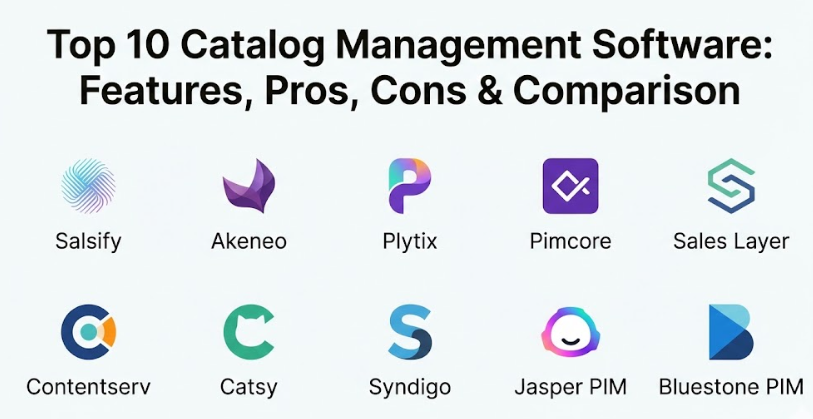
Top 10 Catalog Management Software Tools
1 — Salsify
Salsify is a high-end Commerce Experience Management (CXM) platform that blends PIM, DAM, and experience insights. It is designed for large brands that need to win the “shelf” on major retail sites. Salsify goes beyond simple storage, offering powerful “syndication” tools that automatically format your data to meet the strict requirements of retailers like Amazon or Target.
- Key features:
- Cloud-Native PIM: A highly flexible database for all product attributes.
- Direct Retailer Syndication: Pre-built connections to hundreds of global retailers.
- Integrated DAM: Manage images, videos, and 360-degree views in one place.
- Workflow Automation: Task management for teams to ensure data is complete before launch.
- Enhanced Content: Build “A+ content” modules directly within the platform.
- Insights & Analytics: Track how your products are performing on digital shelves.
- Pros:
- Exceptional at handling the complex requirements of large-scale retail syndication.
- The user interface is built for collaboration, making it easy for large teams to work together.
- Cons:
- One of the most expensive options on the market, which may price out smaller businesses.
- The sheer depth of features means it has a steeper learning curve than simpler PIMs.
- Security & compliance: SOC 2 Type II compliant, SSO support, GDPR readiness, and role-based access controls.
- Support & community: Dedicated account managers, extensive online “Salsify Academy,” and a very active professional user community.
2 — Akeneo
Akeneo is one of the most recognizable names in the PIM space, famous for its user-friendly approach to “enriching” product data. It is designed to help marketers manage thousands of products across multiple locales. Akeneo offers both an open-source version for developers and an enterprise-grade SaaS version for global brands.
- Key features:
- Product Enrichment: A clean dashboard focused on making product descriptions “sales-ready.”
- Asset Manager: Advanced handling of localized images and documents.
- Validation Assistant: AI-driven suggestions to improve the quality of your product data.
- Versioning & Publication: Track changes over time and schedule when updates go live.
- Connect Marketplace: A massive ecosystem of third-party apps and connectors.
- Reference Entities: Manage complex relationships between products (like “fits-into” models).
- Pros:
- Widely considered the most intuitive user interface for marketing teams.
- The “Community Edition” allows businesses to test the waters before committing to a paid plan.
- Cons:
- The Enterprise version can be a significant investment.
- Some users find that the most powerful automation features are locked behind the highest tiers.
- Security & compliance: ISO 27001 certified, GDPR compliant, SSO integration, and full audit trails for data changes.
- Support & community: High-quality documentation, a global network of implementation partners, and 24/7 enterprise support.
3 — Plytix
Plytix is a PIM designed specifically for small and medium-sized businesses (SMBs). It distinguishes itself by being an “all-in-one” tool that is affordable and easy to set up. Unlike enterprise tools that can take a year to launch, Plytix focuses on getting brands up and running in weeks.
- Key features:
- Product Information Management: Centralize all data without the complexity of enterprise tools.
- Product Sheets: Automatically generate PDF catalogs or spec sheets for sales teams.
- E-commerce Channels: Syndicate products directly to Shopify, Amazon, and Google Shopping.
- Brand Portals: Create private web pages where distributors can download your latest product data.
- Unlimited Users: Unlike competitors, Plytix often allows unlimited team members on all plans.
- Bulk Editing: Fast tools to update thousands of attributes at once.
- Pros:
- Excellent value for money, making it accessible to growing brands.
- Known for having the most helpful customer onboarding in the industry.
- Cons:
- Lacks some of the “heavyweight” data governance features found in enterprise-only tools.
- May not handle extremely complex product relationships as well as an MDM-style PIM.
- Security & compliance: GDPR compliant, data encryption at rest and in transit, and SSO available for professional plans.
- Support & community: Dedicated success managers, fast chat support, and a comprehensive help center.
4 — Pimcore
Pimcore is the “Swiss Army Knife” of data management. It is an open-source platform that combines PIM, MDM (Master Data Management), DAM, and even CMS (Content Management) into a single system. It is designed for businesses that want to build a completely custom, highly complex data architecture.
- Key features:
- Multi-Domain Management: Manage product, customer, and vendor data in one spot.
- Digital Asset Management: Advanced manipulation of media, including automatic resizing.
- Print-to-Catalog: Tools to automate the creation of physical, print-ready catalogs.
- Workflow Engine: Highly customizable business processes and approval steps.
- API-First Architecture: Built to be integrated with virtually any other software.
- Personalization: Deliver different data to different users based on their profile.
- Pros:
- Since it is open-source, there are no licensing fees for the community version.
- Unmatched flexibility; if you can imagine a data structure, you can build it in Pimcore.
- Cons:
- Requires a high level of technical expertise to set up and maintain.
- The user interface can feel overwhelming due to the sheer number of configuration options.
- Security & compliance: Highly secure core, support for all major compliance standards (GDPR, ISO), and robust audit logging.
- Support & community: A massive global community of developers and a professional “Enterprise” support branch.
5 — Sales Layer
Sales Layer is a SaaS-based PIM that focuses on agility and ease of use. It is particularly popular for businesses in the mid-market that need a “smart” system to help map their data to various marketplaces. Its standout feature is its “quality score” which helps you identify which products need more work.
- Key features:
- Agile PIM: Designed for quick changes and rapid deployment.
- Quality Reports: Visual indicators of how complete and accurate your data is.
- Amazon Connector: One of the most robust direct links to the Amazon Seller Central.
- Multi-Store Management: Sync data across multiple instances of Shopify or Magento.
- Cloud Hosting: Fully managed infrastructure so you don’t have to worry about servers.
- Intuitive Dashboard: A clean, modern interface that requires little training.
- Pros:
- The “Quality Score” feature is a game-changer for maintaining high data standards.
- Excellent at handling the mapping of complex attributes to different channel requirements.
- Cons:
- May lack the deep custom-coding capabilities that a developer might want from Pimcore.
- Larger enterprises might find the workflow tools less robust than Salsify.
- Security & compliance: GDPR compliant, SSO support, daily backups, and encrypted data storage.
- Support & community: Personalized onboarding, responsive technical support, and detailed video guides.
6 — Contentserv
Contentserv is an AI-driven Product Experience platform that focuses on creating “contextual” content. It is designed to help brands deliver the right product information to the right person at the right time, depending on the channel or region.
- Key features:
- Contextualization: Serve different descriptions or images based on the buyer’s location.
- AI Content Generation: Use integrated AI to write product descriptions at scale.
- Marketing Business Strategy: Tools to align product data with seasonal marketing goals.
- Global DAM: Manage rich media with a focus on high-speed global delivery.
- GDSN Support: Direct integration with the Global Data Synchronization Network.
- Collaborative Workflow: Deep tools for managing large, global teams.
- Pros:
- Exceptional for international brands that need to manage massive localization efforts.
- The integration of AI for content creation can save thousands of hours in copywriting.
- Cons:
- The platform is complex and requires a significant investment in time to implement correctly.
- High cost of ownership makes it more suitable for large enterprises.
- Security & compliance: ISO 27001 certified, GDPR compliant, SOC 2 readiness, and advanced SSO.
- Support & community: Global partner network, professional services, and an extensive training academy.
7 — Catsy
Catsy is a PIM and DAM solution built specifically for brand manufacturers and distributors. It focuses on the specific workflow of a manufacturer—from getting raw data from engineers to turning it into a beautiful catalog for a salesperson.
- Key features:
- Manufacturer Workflow: Specialized tools for the product lifecycle.
- Spec Sheet Creator: Quickly turn technical data into branded PDFs.
- Automatic Channel Mapping: Easily map attributes to the requirements of distributors.
- Centralized DAM: Link media directly to product SKUs automatically.
- InDesign Integration: A dedicated plugin for designers to build catalogs with live data.
- Accuracy Audits: Track who changed what and when for better data accountability.
- Pros:
- The InDesign integration is a huge benefit for companies that still produce high-quality print catalogs.
- Very focused on the needs of manufacturers, avoiding unnecessary “fluff” features.
- Cons:
- Not as widely known for B2C retail-specific features as some other platforms.
- The user interface is functional but can feel a bit traditional compared to Sales Layer.
- Security & compliance: GDPR compliant, SSO support, secure cloud hosting, and robust audit logs.
- Support & community: High-touch customer service, dedicated implementation specialists, and detailed training.
8 — Syndigo
Syndigo (which now includes the Riversand PIM) is a massive “Content Experience Hub.” It is one of the few platforms that manages the entire lifecycle of a product from the manufacturer to the retailer and eventually to the consumer through a single ecosystem.
- Key features:
- Core PIM/MDM: Enterprise-grade master data management.
- Retail Analytics: See exactly how your products look on the retailer’s site in real-time.
- GDSN Connectivity: Built-in tools for global data standards.
- Vendor Portal: Allow your suppliers to upload their data directly into your system.
- Rich Content: Host videos, comparisons, and interactive “hotspots” on product pages.
- Verified Data: Syndigo often provides data verification services to ensure total accuracy.
- Pros:
- The most comprehensive “end-to-end” solution for retail commerce.
- If you sell to major grocery or pharmaceutical chains, Syndigo is often the required standard.
- Cons:
- The system is very large and can be intimidating for smaller organizations.
- Implementation costs can be very high due to the complexity of the data governance.
- Security & compliance: SOC 2 Type II, ISO 27001, GDPR, and HIPAA compliance capabilities.
- Support & community: 24/7 global support, dedicated account managers, and specialized retail training.
9 — Jasper PIM
Jasper PIM is a SaaS-based solution that excels in the “Mid-Market” e-commerce space. It is particularly known for its deep, native integrations with platforms like BigCommerce and Shopify Plus, making it a go-to for growing D2C brands.
- Key features:
- SaaS Architecture: No servers to manage; everything is hosted in the cloud.
- Bidirectional Sync: Sync data to and from your e-commerce storefront.
- Multiple Storefronts: Manage different brands or regions from a single Jasper instance.
- Attribute Mapping: Easily transform your internal data for external channels.
- Promotional Pricing: Manage complex sale prices and schedules across channels.
- Digital Asset Links: Manage media files and have them automatically sync to your store.
- Pros:
- Very easy to set up for teams already using modern e-commerce platforms.
- Provides a great balance between power and price for mid-sized companies.
- Cons:
- May lack some of the deepest “print catalog” features found in Catsy or Pimcore.
- The documentation is good, but the user community is smaller than Akeneo’s.
- Security & compliance: GDPR compliant, SSO support, secure API access, and encrypted data backups.
- Support & community: Responsive support team, dedicated onboarding, and helpful video tutorials.
10 — Bluestone PIM
Bluestone PIM is an API-first, “MACH” (Microservices, API-first, Cloud-native, Headless) architecture platform. It is designed for modern tech stacks where the catalog needs to be shared across apps, websites, and IoT devices.
- Key features:
- API-First: Built from the ground up to be headless and composable.
- App Marketplace: Connect to external tools like AI writers or translation services easily.
- Visual Content Editor: A modern way to manage how products look across devices.
- Bulk Processing: Highly efficient tools for managing millions of SKUs.
- Collaborative Spaces: Shared workspaces for internal teams and external agencies.
- Composability: Only use the features you need and integrate with your existing DAM.
- Pros:
- Perfect for companies with a modern “Headless Commerce” tech stack.
- The UI is incredibly fast and responsive, built with modern web technologies.
- Cons:
- Requires a more modern technical mindset to get the most out of the API-first approach.
- Not ideal for traditional businesses looking for a “legacy-style” desktop experience.
- Security & compliance: ISO 27001 certified, GDPR compliant, SSO support, and advanced encryption.
- Support & community: Fast developer-led support, detailed API documentation, and professional onboarding.
Comparison Table
| Tool Name | Best For | Platform(s) Supported | Standout Feature | Rating (Gartner/True) |
| Salsify | Enterprise Brands | SaaS, Cloud | Retailer Syndication Hub | 4.7 / 5 |
| Akeneo | Marketing-Centric PX | SaaS, Open Source | User Interface/Enrichment | 4.6 / 5 |
| Plytix | SMBs / High Value | SaaS, Cloud | All-in-One Affordability | 4.8 / 5 |
| Pimcore | Custom / Technical | Open Source, On-Prem | Multi-Domain (PIM/DAM/CMS) | 4.5 / 5 |
| Sales Layer | Mid-Market / Agile | SaaS, Cloud | Data Quality Score | 4.7 / 5 |
| Contentserv | Global Localization | SaaS, Cloud | Contextual AI Content | 4.5 / 5 |
| Catsy | Manufacturers | SaaS, Cloud | InDesign / Print Integration | 4.6 / 5 |
| Syndigo | Retail / GDSN | SaaS, Cloud | End-to-End Retail Hub | 4.4 / 5 |
| Jasper PIM | D2C / Shopify Plus | SaaS, Cloud | Bidirectional Sync | 4.6 / 5 |
| Bluestone PIM | Headless Commerce | SaaS, API-First | Composable MACH Architecture | 4.7 / 5 |
Evaluation & Scoring of Catalog Management Software
When we evaluate catalog management software, we look at several weighted categories that impact long-term ROI. The following rubric explains how these tools are measured in the 2026 market.
| Category | Weight (%) | Content / Evaluation Criteria |
| Core Features | 25% | Ability to handle bulk editing, digital asset management, and complex attributes. |
| Ease of Use | 15% | Intuitiveness of the UI for non-technical marketing and sales teams. |
| Integrations | 15% | Availability of pre-built connectors for Shopify, Amazon, ERPs, and CRMs. |
| Security & Compliance | 10% | Presence of SSO, SOC 2, GDPR compliance, and detailed audit trails. |
| Performance | 10% | Speed of the cloud interface and reliability of the data syndication sync. |
| Support & Community | 10% | Quality of onboarding, documentation, and the size of the user ecosystem. |
| Price / Value | 15% | Cost of the software relative to the time saved and revenue generated. |
Which Catalog Management Software Tool Is Right for You?
Selecting a tool depends heavily on your current business stage and your future growth plans.
Solo Users vs SMB vs Mid-Market vs Enterprise
If you are an SMB looking for your first PIM, Plytix or Sales Layer are the clear winners. They offer a “human” approach with fast setup. Mid-market companies with complex needs but a need for speed should look at Jasper PIM or Bluestone. For global Enterprises with massive datasets and strict compliance needs, Salsify, Akeneo, or Syndigo are the standard-bearers.
Budget-Conscious vs Premium Solutions
If budget is your primary concern, Pimcore (Community Edition) offers infinite power for the price of your developers’ time. For businesses that want a fixed, affordable SaaS fee, Plytix is hard to beat. If you have a large budget and need a tool that “guarantees” your placement on retail shelves, Salsify is a premium investment that pays for itself in market share.
Feature Depth vs Ease of Use
Do you need every possible feature, including print automation and customer data management? Pimcore and Contentserv are deep but complex. If you want a tool that your marketing team will actually enjoy using every day, Akeneo and Sales Layer focus heavily on a clean, modern user experience.
Integration and Scalability Needs
If you are building a modern, “Headless” tech stack, Bluestone PIM‘s API-first approach is the future. If you are deeply integrated into the “Legacy” retail world with GDSN requirements, Syndigo provides the most reliable connectivity to traditional supply chains.
Frequently Asked Questions (FAQs)
1. What is the difference between PIM and Catalog Management?
Catalog Management is the process of organizing product data, while a PIM (Product Information Management) is the software tool used to do it. Most modern “Catalog Management Software” is essentially a PIM with added features like digital asset management and channel syndication.
2. How long does it take to implement these tools?
SMB-focused tools like Plytix can be up and running in 4 to 8 weeks. Enterprise-level implementations for Salsify or Contentserv can take 6 months to a year, depending on the complexity of your data and the number of integrations required.
3. Do I still need spreadsheets if I have catalog management software?
You might still use spreadsheets for quick “scratchpad” work, but the goal of this software is to eliminate spreadsheets as the “source of truth.” You should be able to import and export CSVs, but the software is where the data lives.
4. Can these tools help with SEO?
Yes. By ensuring that your product descriptions are complete, high-quality, and keyword-rich across all channels, you improve your search rankings on both Google and marketplace-specific search engines like Amazon.
5. Does the software handle product images and videos?
Yes, most top-tier tools include a Digital Asset Management (DAM) component. This allows you to link specific images to specific SKUs and automatically resize them for different channel requirements.
6. Can I manage different prices for different countries?
Absolutely. One of the core strengths of catalog management software is “localization”—the ability to have one product with different prices, languages, and technical specs for different regions.
7. How do these tools integrate with my existing ERP?
Most tools use either pre-built connectors (like for SAP or Microsoft Dynamics) or a robust API. The ERP typically handles the “transactional” data (stock levels, costs), while the PIM handles the “marketing” data (descriptions, images).
8. Is my data secure in the cloud?
Reputable SaaS providers use enterprise-grade security, including data encryption, daily backups, and SOC 2 compliance. For businesses with extreme security needs, open-source options like Pimcore can be hosted on your own private servers.
9. Will this software help me sell on Amazon?
Yes, tools like Salsify and Sales Layer have specialized “connectors” that map your data to Amazon’s specific requirements, reducing the chance of your listings being rejected for missing information.
10. What is “Data Enrichment”?
Enrichment is the process of taking raw data (like a SKU and a basic name) and adding “marketing” value to it—such as professional descriptions, benefit-driven bullet points, and high-quality media. This is where these tools shine.
Conclusion
The “best” catalog management software is not the one with the most features, but the one that your team will actually use and that fits your current sales channels. For those prioritizing ease of use and marketing enrichment, Akeneo and Sales Layer are exceptional. If you are a manufacturer needing print-ready data, Catsy or Pimcore are the clear choices. For enterprise giants, the syndication power of Salsify and Syndigo remains unmatched.
Choosing a platform is a long-term commitment. Remember that the software is only as good as the data you put into it. Start by auditing your current product information, identifying your most important sales channels, and selecting a partner that can grow with your ambitions. In the digital-first world of 2026, your product data is your product.