Introduction
A customer referral platform is a software solution designed to automate the process of turning satisfied customers into active brand advocates. These platforms manage the end-to-end referral lifecycle: from generating unique referral links for every customer and tracking clicks to verifying conversions and automatically fulfilling rewards. Unlike a simple “invite a friend” link, a dedicated platform ensures that every step of the journey is frictionless for both the referrer and the person being referred. In 2026, these tools have evolved to include sophisticated AI-driven fraud detection, social-first sharing templates, and server-side tracking to navigate modern privacy restrictions.
The importance of these platforms lies in their ability to drive high-quality customer acquisition at a significantly lower cost than paid channels. Real-world use cases span from e-commerce brands offering discounts for referrals to B2B SaaS companies providing account credits for every new corporate lead. When choosing a platform, evaluation criteria should include integration depth (how well does it talk to your CRM or store?), reward flexibility (can it handle cash, points, and physical goods?), and mobile optimization, as over 70% of referral clicks now occur on mobile devices.
Best for: Marketing directors, growth managers, and business owners at tech startups, growth-stage e-commerce brands, and professional service firms. It is most effective for businesses with a high Net Promoter Score (NPS) and a healthy transaction volume (typically 100+ per month) where customers are already naturally inclined to share.
Not ideal for: Early-stage startups that haven’t yet found product-market fit or businesses with low customer satisfaction scores. If your core product is struggling, a referral program may backfire by magnifying negative sentiment. Additionally, businesses with extremely low-frequency purchases (like real estate or luxury car sales) may find better results with manual high-touch ambassador programs rather than automated software.
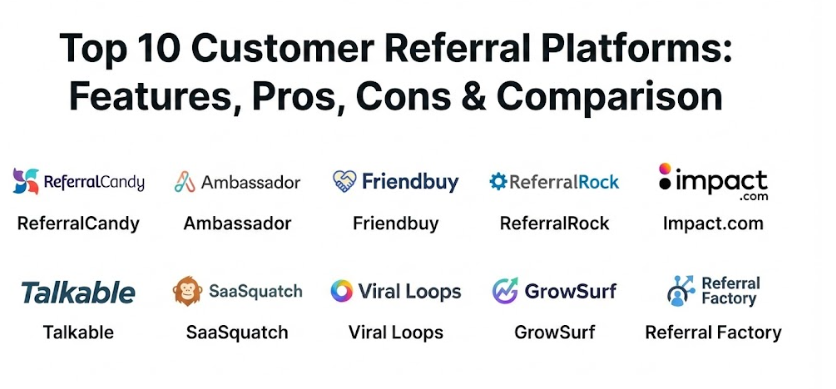
Top 10 Customer Referral Platforms Tools
1 — ReferralCandy
ReferralCandy is a veteran in the e-commerce space, specifically designed to help online stores grow their sales through automated word-of-mouth. It is built for simplicity, allowing small-to-mid-sized retailers to launch a professional program without touching a line of code.
- Key features:
- Automatic Post-Purchase Invites: Triggers referral invitations immediately after a customer makes a purchase.
- Revenue Tracking: A dedicated dashboard showing exactly how much referral-driven revenue has been generated.
- Social-First Templates: Pre-designed sharing formats for Instagram, TikTok, and WhatsApp.
- Automated Reward Delivery: Sends coupon codes or cash rewards directly to referrers without manual intervention.
- Fraud Detection: Sophisticated algorithms to flag self-referrals and suspicious link-sharing patterns.
- E-commerce Direct Integrations: One-click setups for Shopify, BigCommerce, and WooCommerce.
- Pros:
- The setup is incredibly fast, often taking less than 30 minutes to go live.
- It offers a very high “set it and forget it” value, requiring minimal daily management.
- Cons:
- The UI can feel a bit restrictive for brands that want a 100% custom look.
- Pricing includes a commission-based component that can become expensive for high-volume stores.
- Security & compliance: Fully GDPR and CCPA compliant. It uses 256-bit AES encryption for data at rest and supports secure payment gateways for cash reward fulfillment.
- Support & community: Offers a comprehensive knowledge base, 24/7 email support, and a growing community of e-commerce experts who share strategy blueprints via the ReferralCandy blog.
2 — Ambassador
Ambassador is an enterprise-grade platform that handles more than just simple customer referrals; it manages affiliates, influencers, and brand fans in a single unified dashboard. It is designed for companies that need a high level of customization and deep CRM integration.
- Key features:
- Omni-Channel Management: Track referrals across web, mobile apps, and physical stores.
- Multi-Campaign Support: Run separate programs for customers, partners, and employees simultaneously.
- HiroAI Orchestration: AI-powered layer that suggests the best time to ask a customer for a referral based on their interactions.
- Visual Campaign Builder: A drag-and-drop editor for creating on-brand referral portals.
- Advanced Attribution: Detailed tracking that follows the customer journey from the first click to the final sale.
- Vaults & Ledgers: A high-trust system for managing complex reward payouts and financial audits.
- Pros:
- The platform is extremely flexible, supporting virtually any reward structure or referral logic.
- Excellent for large organizations that need to sync referral data with Salesforce or HubSpot.
- Cons:
- The onboarding process is extensive and usually requires several weeks of setup.
- It is priced at a premium, making it inaccessible for most early-stage small businesses.
- Security & compliance: Enterprise-ready with SOC 2 Type II certification, SAML/SSO support, and detailed audit logs for every user action.
- Support & community: Provides dedicated success managers for enterprise clients, in-person training sessions, and a private user forum for high-level marketing strategy.
3 — Friendbuy
Friendbuy is a growth-focused platform that has powered some of the world’s most recognizable consumer brands. It focuses heavily on A/B testing and optimization to ensure that every referral campaign is performing at its peak.
- Key features:
- Dynamic A/B Testing: Easily test different reward offers and creative assets to see what drives more sharing.
- Tiered Rewards: Create structures where referrers get bigger bonuses for every third or fifth friend they bring in.
- Mobile-Optimized Widgets: Lightweight referral overlays that load instantly on mobile devices.
- Real-Time Analytics: Live reporting on sharing rates, conversion rates, and total viral growth.
- Custom Referral Triggers: Set specific conditions (like a minimum purchase amount) before a reward is triggered.
- Integration Marketplace: Strong native connections with Klaviyo, Segment, and Stripe.
- Pros:
- The A/B testing suite is a “game-changer” for refining and improving program ROI over time.
- Customer support is frequently praised for being proactive and knowledgeable about referral psychology.
- Cons:
- Customizing widgets beyond the standard templates often requires developer resources.
- Some advanced features, like tiered rewards, require a higher-priced subscription tier.
- Security & compliance: GDPR compliant and uses encrypted API endpoints for all data transfers. It includes robust fraud rules that can be tailored to specific business risks.
- Support & community: Offers premium onboarding services, phone support for professional plans, and a rich library of case studies and video tutorials.
4 — ReferralRock
ReferralRock is designed for businesses that want a powerful program without needing a developer. It focuses on the “Referral Website” concept, providing a dedicated portal for your advocates to manage their links and track their own rewards.
- Key features:
- Dedicated Member Portal: A login area for your customers to see their referral history and available rewards.
- Concierge Onboarding: Every customer gets a dedicated advisor to help build their program.
- Buyer Stage Rewards: Reward advocates when a lead moves through different stages (e.g., “Got a Quote” or “Booked a Demo”).
- Email Automation: Built-in email tool for sending launch campaigns and reward notifications.
- One-Click Sharing: Frictionless buttons that let users share their unique link via any messaging app.
- No-Code Integration: Uses simple code snippets and Zapier to connect with almost any business tool.
- Pros:
- It is one of the most versatile tools for B2B and service-based businesses, not just e-commerce.
- The “Member Portal” makes advocates feel more like true partners rather than just casual referrers.
- Cons:
- The interface, while functional, is not as visually “slick” as some of its competitors.
- Managing high-velocity e-commerce programs can feel a bit manual compared to ReferralCandy.
- Security & compliance: State-of-the-art security featuring data encryption and full compliance with GDPR and CCPA. Incorporates IP tracking for advanced fraud prevention.
- Support & community: Known for its “human-first” support with dedicated advisors and technical integration assistance for every new client.
5 — Impact.com (Advocate)
Impact.com is a global leader in partnership management. Their “Advocate” solution allows brands to manage their customer referrals alongside their traditional affiliate and influencer programs for a unified growth strategy.
- Key features:
- Unified Dashboard: View and manage every type of brand partner in one central location.
- On-Brand Microsites: Build fully branded landing pages that look and feel like part of your website.
- Motivational Incentives: Create leaderboards and reward exchanges to keep advocates engaged.
- First-Party Tracking: Uses modern “Universal Tracking” to ensure accuracy despite browser privacy changes.
- Automated Workflows: Set up rules to handle everything from partner approval to reward payouts.
- Comprehensive ROI Reporting: Deep analytics that prove the value of word-of-mouth against other channels.
- Pros:
- It is the most powerful solution for companies that want to scale a global partnership ecosystem.
- Conversion rates for referrals managed through Impact are reported to be up to 253% higher than other traffic.
- Cons:
- The platform is highly complex and has a steep learning curve for new users.
- Some legacy components still use “redirect hops” which can be blocked by certain modern browsers.
- Security & compliance: Enterprise-grade security with ISO 27001 certification and support for complex data audit logs.
- Support & community: Exceptional global support, a dedicated academy for partnership training, and access to a massive marketplace of potential partners.
6 — Talkable
Talkable is a mid-market and enterprise solution that focuses on high-level strategy and A/B testing. It is known for its “Managed Service” approach, where they act as an extension of your marketing team.
- Key features:
- Strategic Campaign Design: Tools for building complex referral logic tailored to specific business goals.
- Intelligent Fraud Control: Real-time monitoring and automated enforcement against program abuse.
- Multi-Language Support: Perfect for brands operating across different global regions.
- Customizable UI/UX: High level of design control over every referral touchpoint.
- Segmentation: Target specific customer groups with unique referral offers.
- Detailed Funnel Analysis: Track performance from the referral invite to the final conversion.
- Pros:
- The platform is highly configurable, making it a great fit for businesses with unique operational challenges.
- Customer support is frequently commended for providing strategic insights, not just technical help.
- Cons:
- Implementation can be slow for companies that lack an internal technical team.
- The pricing structure is not transparent and generally starts at a higher entry point.
- Security & compliance: GDPR and CCPA compliant. Offers secure SSO and enterprise-level encryption for customer data.
- Support & community: Highlights a “Class-A” support experience with proactive account management and a focus on data-driven decision making.
7 — SaaSquatch
SaaSquatch is a loyalty and referral platform designed specifically for the digital and subscription-based business world. It excels in handling the complexities of recurring billing and mobile app environments.
- Key features:
- Flexible Theming Engine: Customize referral touchpoints to match your app’s exact look and feel.
- Multi-Campaign Management: Run loyalty, referral, and “win-back” programs from one dashboard.
- Mobile SDK & API: Robust tools for developers to build referral experiences directly into mobile apps.
- Automated Fulfillment: Native integrations with Tango Card and Stripe for instant reward delivery.
- Real-Time Participant Tracking: Monitor advocate activity and referral status in real-time.
- Advanced Fraud Algorithms: Specialized detection for SaaS-specific referral abuse patterns.
- Pros:
- It is widely considered the best choice for SaaS and subscription companies due to its native integrations with Recurly and Stripe.
- The “Share Links” are mobile-optimized by default, ensuring a high conversion rate on smartphones.
- Cons:
- The starting price is higher than many “starter” tools, reflecting its enterprise focus.
- Initial setup requires more technical involvement than no-code alternatives like GrowSurf.
- Security & compliance: Built on a secure cloud infrastructure with GDPR support and sophisticated security management features.
- Support & community: Offers a dedicated knowledge base, chat support, and extensive documentation for technical teams.
8 — Viral Loops
Viral Loops is a “growth hacking” tool that provides proven blueprints for viral marketing. It is famous for its “Waiting List” and “Milestone” templates that help startups build massive buzz before they even launch.
- Key features:
- Inspired Campaign Templates: Blueprints based on successful programs from companies like Robinhood and Dropbox.
- Milestone Referrals: Reward users as they reach different referral counts (e.g., 5, 10, or 25 friends).
- No-Code Visual Editor: Customize the appearance of referral pages without needing a developer.
- Live Leaderboards: Create a sense of competition to drive more sharing.
- Two-Sided Incentives: Easily set up “Give $10, Get $10” structures that appeal to both parties.
- Widget Hosting: Host your referral program on a dedicated Viral Loops page or embed it in your own.
- Pros:
- The template-based approach removes the “marketing guesswork” for busy founders.
- It is very affordable for early-stage startups and offers a generous “Start-up” plan.
- Cons:
- It lacks the deep CRM and enterprise audit features of tools like Ambassador.
- Customizing beyond the pre-set templates can be difficult for non-technical users.
- Security & compliance: Standard SSL encryption and GDPR compliance. Data minimization strategies are used to collect only essential information.
- Support & community: Provides a guided setup wizard, helpful strategy blog, and email support for all plan tiers.
9 — GrowSurf
GrowSurf is a “set it and forget it” referral software designed primarily for B2B and B2C tech startups. It focuses on frictionless sharing, where users don’t even have to sign up to start referring their friends.
- Key features:
- Automatic Link Generation: Every user in your system gets a unique link automatically without needing to register.
- Copy-and-Paste Install: Launch a program by adding a few lines of code to your website.
- Fully White-Labeled: The program blends perfectly into your UI, so users never feel like they’ve left your site.
- AI-Powered Optimization: Automatically suggests tweaks to your program to increase results.
- Automated Fulfillment: Connect with PayPal or Stripe to pay out cash rewards on autopilot.
- Robust REST API: Deep developer tools for building custom, in-product referral flows.
- Pros:
- It offers incredible value for money, often paying for itself within the first few months.
- The frictionless “No-Signup” sharing significantly increases the percentage of customers who take part.
- Cons:
- It is primarily focused on tech companies; e-commerce brands might find it lacks specialized store features.
- Support is mostly via chat and email; there are no dedicated account managers for lower plans.
- Security & compliance: GDPR compliant and uses secure webhooks for data communication. It includes built-in fraud prevention tools like IP tracking and email verification.
- Support & community: Features a very high user rating for ease of use and offers a detailed knowledge base and responsive technical chat support.
10 — Referral Factory
Referral Factory is a versatile platform that emphasizes its massive library of over 1,000 pre-designed referral templates. It is designed to work across almost any industry, from financial services to solar energy.
- Key features:
- 1,000+ Templates: Industry-specific designs that include everything from copy to rewards.
- Multi-Language Capabilities: Access referral programs in over 21 different languages.
- CRM Two-Way Sync: Seamlessly pull and push data to tools like Salesforce, HubSpot, and Pipedrive.
- Secure User Verification: Optional secure login to prevent fraudulent entries.
- White-Label Domain: Host your referral program on your own custom domain.
- Tremendous Integration: Native access to 200+ reward types including Amazon vouchers and charity donations.
- Pros:
- The variety of industry-specific templates makes it the easiest tool to get started with for non-tech businesses.
- All plans offer the full suite of tools, so you aren’t “locked out” of features on the starter plan.
- Cons:
- The UI can occasionally be confusing because of the sheer number of options available.
- You have to pay an additional fee to remove the “Referral Factory” branding and use your own domain.
- Security & compliance: Features built-in fraud alerts and financial compliance tools. It is GDPR compliant and supports secure login for all participants.
- Support & community: Provides chat and video support on all plans, with a high rating for customer service responsiveness.
Comparison Table
| Tool Name | Best For | Platform(s) Supported | Standout Feature | Rating (G2/GetApp) |
| ReferralCandy | E-commerce Stores | Shopify, WooCommerce, BigCommerce | Automated post-purchase invites | 4.8 / 5 |
| Ambassador | Enterprise Organizations | Web-based, Cloud, API | HiroAI Orchestration | 4.6 / 5 |
| Friendbuy | Growth Optimization | Web, Mobile, iOS/Android SDK | Powerful A/B Testing | 4.7 / 5 |
| ReferralRock | B2B & Service-based | Web, Mobile, SaaS, CRM | Concierge Onboarding | 4.8 / 5 |
| Impact.com | Global Partnerships | Web, Mobile App, Global | Unified Partnership Ecosystem | 4.5 / 5 |
| Talkable | Mid-Market Brands | Web, Mobile, Cloud | Managed Service Support | 4.5 / 5 |
| SaaSquatch | SaaS & Subscription | Web, Mobile SDK, API | Flexible Theming Engine | 4.6 / 5 |
| Viral Loops | Startup Viral Growth | Web, No-code pages | Milestone Referral Blueprints | 4.6 / 5 |
| GrowSurf | Tech & SaaS Startups | Web, Product-Embedded | Frictionless Auto-Link Gen | 4.8 / 5 |
| Referral Factory | Versatile Industry Use | Web, CRM, 21+ Languages | 1,000+ Industry Templates | 4.9 / 5 |
Evaluation & Scoring of Customer Referral Platforms
Choosing the right platform is more than just looking at a feature list; it’s about weighing the factors that will most impact your specific business model.
| Category | Weight (%) | What we Evaluate | Avg. Score |
| Core Features | 25% | Tracking accuracy, reward types, and template quality. | 9.0 |
| Ease of Use | 15% | Setup time, dashboard intuition, and member experience. | 8.5 |
| Integrations | 15% | Native CRM/Store connections and API robustness. | 8.2 |
| Security & Compliance | 10% | Fraud detection, GDPR, and data encryption. | 9.2 |
| Performance | 10% | Load speeds, mobile optimization, and uptime. | 8.8 |
| Support & Community | 10% | Response times, onboarding, and training materials. | 8.4 |
| Price / Value | 15% | Feature depth relative to cost and ROI potential. | 8.0 |
Which Customer Referral Platform Tool Is Right for You?
The “perfect” tool depends on your team’s technical skill, your budget, and who your customers are.
Solo Users vs SMB vs Mid-Market vs Enterprise
If you are a solo founder or a very small team, focus on tools like GrowSurf or Viral Loops. They are designed for quick launches with minimal technical oversight. SMBs in the e-commerce space should almost always start with ReferralCandy due to its effortless integration. Mid-market companies with complex sales cycles will benefit most from ReferralRock or Talkable, which provide the strategic depth needed to manage longer lead times. Enterprise companies requiring global compliance and massive scale should look no further than Impact.com or Ambassador.
Budget-Conscious vs Premium Solutions
For those watching every penny, Google Family Link or simple Viral Loops plans offer high value at a low entry point. If you have a marketing budget and want to maximize ROI through science and testing, premium solutions like Friendbuy or SaaSquatch are worth the investment because their A/B testing and AI features can often double the results of a basic program.
Feature Depth vs Ease of Use
If you want to be live today with zero help from a developer, Referral Factory or GrowSurf are your winners. However, if you have a product team and want to build a deeply embedded referral experience that feels like a core part of your app, the “API-first” approach of SaaSquatch or Friendbuy will give you the flexibility you need.
Integration and Scalability Needs
Consider where your customer data currently lives. If everything is in Salesforce, choosing a tool like Ambassador that has a deep, two-way native sync is non-negotiable. For scalability, ensure the platform can handle “Viral Spikes”—Impact.com and GoFundMe Pro (mentioned in a similar context) are battle-tested for handling millions of clicks during major campaigns.
Frequently Asked Questions (FAQs)
1. How do customer referral platforms prevent fraud?
In 2026, most platforms use AI-powered behavioral analysis. They track IP addresses, device fingerprints, and referral velocity. If a single person refers 50 people in one minute, the system flags it. Advanced tools like Talkable and ReferralRock also use social verification to confirm genuine relationships.
2. Do I need a developer to set these up?
Not necessarily. Tools like ReferralCandy and GrowSurf are “no-code,” meaning you simply copy a snippet of code into your site or click a button in your e-commerce store. However, enterprise tools like Ambassador usually require some technical help for deep CRM syncing.
3. What is the average conversion rate for a referral?
While it varies by industry, 2026 benchmarks show that referred leads convert at 2.1% to 6.2%. More importantly, these customers typically have a 16% to 25% higher lifetime value (LTV) than those acquired through paid ads.
4. What kind of rewards work best?
Discounts are standard, but experience-based rewards—like early access to products or exclusive events—are outperforming cash in 2026. “Two-sided” rewards (where both the friend and the referrer get something) are essential for high participation.
5. How do I navigate iOS privacy changes with referral tracking?
Standard cookies are often blocked now. Look for platforms that offer server-side tracking or first-party data collection (like Impact.com or Friendbuy). This ensures your referrals are attributed correctly even when browsers block third-party trackers.
6. Can I run a referral program if I’m in a high-compliance industry like Fintech?
Yes. Platforms like SaaSquatch and Referral Factory have specialized tools for financial compliance and data minimization to meet strict regulations.
7. How much does referral software cost?
Starter plans usually begin around $49-$179 per month. Mid-market solutions range from $500 to $1,500, while enterprise contracts can exceed $20,000 per year depending on the volume of referrals managed.
8. Should I give cash or store credit?
Store credit is better for retention because it forces the customer to come back and buy again. Cash (via PayPal or Visa cards) is better for “one-off” products where the customer might not need to buy again soon.
9. Is a referral program better than an affiliate program?
Referrals are for your customers to share with friends. Affiliates are professional marketers who promote you for a commission. Referral programs often drive higher quality leads because they are based on a real relationship.
10. What is the most common mistake in referral marketing?
Making it too hard to find the link. If a customer has to click more than twice to find their referral link, they won’t share it. Friction is the enemy of viral growth.
Conclusion
Choosing a customer referral platform is one of the most significant levers you can pull to drive sustainable, low-cost growth. The “best” platform is the one that fits your specific business mechanics—whether that is the automated ease of ReferralCandy, the startup blueprint of Viral Loops, or the enterprise power of Ambassador.
As you move forward, remember that technology is only half the battle. The most successful referral programs are built on the foundation of an exceptional product. If your customers are happy, the right platform will simply give them the voice and the incentive they need to build your brand for you. In 2026, word-of-mouth isn’t just something that happens; it’s something you engineer.