Introduction
Imagine running a busy digital store. One day, a huge sale starts. Thousands of shoppers rush to your website at the exact same minute. Suddenly, the payment page freezes, error codes flash on the screen, and customers leave angry.
Every minute your system goes down, your business loses money and trust.
Back in the day, companies relied only on system administrators to manually reboot crashed servers. Today, modern platforms are too complex for manual fixes. This is where Site Reliability Engineering comes in. SRE helps tech teams catch problems before they hurt customers, fix broken code automatically, and keep systems running 24 hours a day, 7 days a week.
This guide breaks down SRE best practices into simple terms. You will learn how modern teams keep business platforms online, avoid costly outages, and grow their software safely.
What Is SRE (Site Reliability Engineering)?
Site Reliability Engineering is a practice created by Google in the early 2000s. It bridges the gap between software developers who write new code and system administrators who keep servers running.
Simple Meaning
Think of SRE as an insurance policy for your software. Developers want to launch new features quickly. Business owners want the platform to never crash. SREs find the middle ground by using automation and engineering principles to make sure new updates do not break the live system.
Why It Matters
Without SRE, development teams and operations teams often fight. Developers blame the servers when code fails, and operations teams blame the developers for writing bad code. SRE unites them under one goal: keeping the customer happy by keeping the platform reliable.
Core SRE Concepts Every Business Should Know
To understand how high availability works, you need to know three major building blocks that SRE teams use every day.
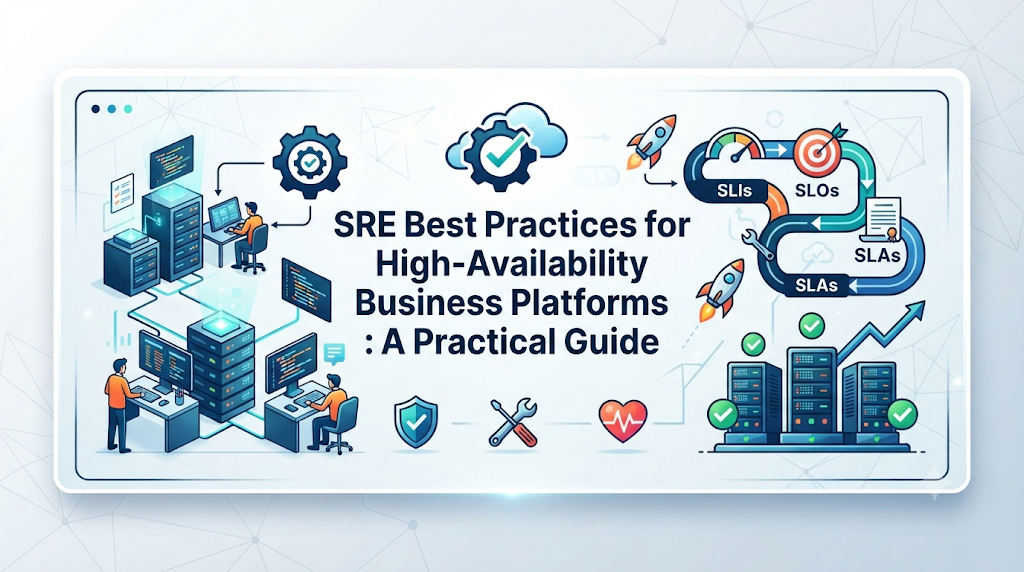
1. Service Level Indicators (SLIs)
- Simple Meaning: A yardstick that measures how your system is performing right now.
- Why it matters: You cannot fix what you do not measure. If your users want fast page loads, your SLI might measure how many seconds it takes for a page to open.
2. Service Level Objectives (SLOs)
- Simple Meaning: Your internal goal for how reliable your system should be.
- Why it matters: 100% uptime is impossible and too expensive. An SLO sets a realistic target, such as “Our login page must work 99.9% of the time over a 30-day window.”
3. Service Level Agreements (SLAs)
- Simple Meaning: A formal promise or contract you make with your paying customers.
- Why it matters: If you miss your SLA promise—meaning the system goes down more than allowed—your business might have to pay financial penalties or refund customers.
How High Availability Works in Practice
High availability means your platform keeps running even when individual parts fail. If one server catches fire or loses power, backup systems take over instantly without the user noticing.
The Power of Redundancy
Imagine a restaurant kitchen with only one chef. If that chef gets sick, the restaurant closes. High availability avoids this by having backup chefs standing by. In software, this means running your app across multiple servers in different data centers. If server A crashes, traffic automatically routes to server B in milliseconds.
Load Balancing: Spreading the Weight
A load balancer acts like a smart traffic cop at the entrance of a theme park. When millions of visitors arrive, the load balancer sends people to different ticket counters so no single line gets too crowded. This keeps your platform fast and balanced.
Practical SRE Best Practices for Your Platform
If you want to build a reliable business platform, follow these proven strategies used by top engineering teams.
1. Define Clear Error Budgets
An error budget is a clever rule. It measures how much downtime or failure your system is allowed to have over a month.
- How it works: If your SLO is 99.9% uptime, your error budget allows for about 43 minutes of downtime per month.
- The rule: If you have plenty of error budget left, developers can launch new features fast. If you run out of error budget because the system keeps crashing, all new feature launches stop until reliability is fixed. This balances speed with safety.
2. Automate Repetitive Toil
“Toil” is manual, repetitive work that does not add long-term value. Restarting servers by hand every morning is toil. SREs hate toil. They write automated scripts so computers handle boring maintenance tasks. This frees up engineers to solve harder, more creative problems.
3. Practice Incident Management and Blameless Post-Mortems
When things break, pointing fingers at people does not fix the code. A blameless post-mortem is a meeting held after an outage where the team investigates what went wrong in the system, not who made the mistake.
- Example: Instead of saying, “John deployed bad code,” the team says, “Our deployment checklist missed a database check.” This helps fix the process so the same mistake never happens twice.
4. Use Infrastructure as Code (IaC)
In the past, setting up a new server meant buying physical hardware and plugging it in by hand. Today, teams use code to build servers in the cloud. Infrastructure as Code means your entire computer setup is written down in configuration files. If your production server breaks, you can spin up an exact carbon copy in minutes with a single click.
Common Mistakes Beginners Make
Even smart teams make mistakes when trying to make their platforms reliable. Watch out for these common traps:
- Mistake: Chasing 100% Uptime. Trying to make a system never fail costs too much money and slows down product growth. Aim for realistic targets like 99.9% or 99.99%.
- Mistake: Ignoring Monitoring until an Outage Happens. Setting up alerts only after a major crash leaves you flying blind. Monitor your system health proactively.
- Mistake: Treating SRE as a Job Title, Not a Mindset. Hiring one “SRE engineer” will not fix a broken company culture. Reliability requires teamwork between developers, testers, and operations staff.
Risks and Limitations of SRE
While SRE is powerful, it is not a magic wand. Keep these limitations in mind:
- High Initial Setup Cost: Writing automation scripts and setting up deep monitoring takes time and skilled engineers before you see the benefits.
- Complexity Overhead: Managing cloud infrastructure, automated pipelines, and telemetry tools requires technical know-how that small startups might struggle to staff.
- Not Suitable for Every Project: A simple internal blog or prototype app does not need complex SRE practices. SRE shines brightest on revenue-generating, high-traffic business platforms.
Decision Framework: When to Implement SRE Practices
Use this simple step-by-step framework to decide when your business needs formal SRE practices:
- Calculate the Cost of Downtime: Estimate how much money your business loses every hour your platform is offline.
- Evaluate Traffic and User Growth: If your user base is growing fast and manual server reboots can no longer keep up, you need SRE.
- Assess Team Capacity: Check if your engineers spend more time fixing fires than building new features. If yes, introduce toil reduction and automation.
- Start Small: Do not try to adopt every SRE tool at once. Start by defining your first SLI and setting up basic automated alerts.
Key Terms
- Downtime: The period when a system is unavailable or fails to provide its core service to users.
- Observability: How well you can understand the internal state of a system by looking at its outputs (logs, metrics, and traces).
- Failover: The automatic switch to a backup system or server when the primary system fails.
- Latency: The time it takes for data to travel from one point to another, often measured as page load speed.
- Telemetry: The automated collection and sending of data from remote devices to monitoring systems.
- Post-Mortem: A structured review meeting held after an operational failure to understand root causes and prevent future occurrences.
- Runbook: A step-by-step operational guide that helps engineers perform routine maintenance or handle emergency outages.
- CI/CD (Continuous Integration / Continuous Delivery): Practices that automate the building, testing, and releasing of software updates.
FAQs
What is the difference between DevOps and SRE?
DevOps is a cultural philosophy focused on breaking down walls between developers and operations teams to ship code faster. SRE is a specific way to implement DevOps, focusing heavily on measuring reliability, managing risk, and using software engineering to solve operations problems.
How much uptime is 99.9% (the “three nines” rule)?
A 99.9% uptime target allows for about 8 hours and 46 minutes of total downtime per year. For comparison, 99.99% (“four nines”) allows for only about 52 minutes of downtime per year.
Do small businesses need Site Reliability Engineering?
Small businesses with low web traffic usually do not need a dedicated SRE team. However, adopting basic SRE principles—like automated backups, good monitoring, and tracking uptime—helps any business protect its digital revenue.
What tools do SRE teams use?
SREs use monitoring and logging tools (like Prometheus, Grafana, or Datadog), cloud platforms (like AWS, Google Cloud, or Azure), and container orchestration tools (like Kubernetes) to manage and automate platform infrastructure.
Who is responsible for system reliability in a company?
While SRE teams lead the strategy and tooling, reliability is a shared responsibility. Developers write clean code, product managers factor reliability into launch schedules, and executive leadership supports investment in system health.
Conclusion
Keeping a business platform online requires more than hope and luck. By treating system operations like software engineering, setting clear reliability targets, and automating repetitive maintenance tasks, you can protect your revenue and build customer trust. Start small by measuring your current system performance, automate your biggest operational headache, and scale your reliability practices as your platform grows.