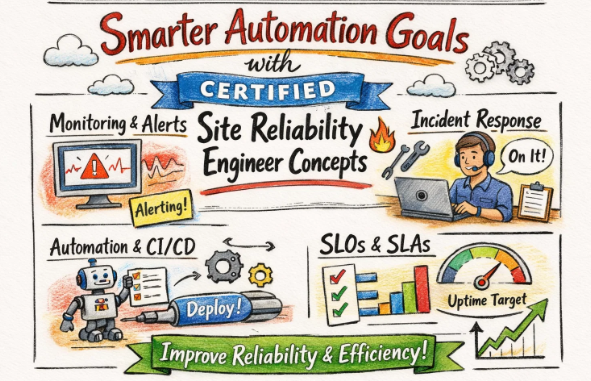
Introduction
A significant change in the way software is managed in production is currently being observed. The traditional boundaries between development and operations are being removed to create a more integrated workflow. Site Reliability Engineering is used to ensure that services remain reliable, scalable, and efficient. By applying engineering principles to operational tasks, a higher level of performance is achieved.
The journey toward professional mastery is often supported by formal certification. A structured path is provided for engineers in India and across global markets to validate their expertise. This guide is intended to be a comprehensive resource for those who wish to advance their careers by becoming a Certified Site Reliability Engineer. Practical advice and industry perspectives are shared to assist in this professional transition.
What is Certified Site Reliability Engineer
The Certified Site Reliability Engineer program is a professional validation of an individual’s ability to run large-scale, distributed systems. It is not considered a basic course; instead, it is a deep dive into the engineering practices that keep modern applications running. The curriculum is designed to cover the core pillars of SRE, including automation, monitoring, and incident management.
A heavy emphasis is placed on the practical application of these principles. By completing this program, a clear understanding of how to balance new feature releases with system stability is gained. The certification is recognized as a mark of technical competence in the cloud-native era.
Why it Matters Today?
The cost of system downtime is seen to be higher than at any point in history. When a service is unavailable, it is not just revenue that is lost, but also customer trust. Therefore, experts who can guarantee high availability are in high demand. Modern infrastructure is moving toward microservices and containerization, which adds layers of complexity.
Manual intervention is no longer thought to be efficient for managing thousands of servers. Automation is required to maintain these environments. A Certified Site Reliability Engineer is trained to treat operations as a software problem. This approach allows for the reduction of manual toil, allowing engineers to focus on high-value projects that improve the overall resilience of the system.
Why Certified Site Reliability Engineer Certifications are Important
A standardized knowledge base is established through this certification. While SRE practices can differ between companies, a global standard is followed within this program. This ensures that a common language is used by reliability teams across the industry.
The following benefits are identified when this certification is obtained:
- Professional Validation: Competency in managing complex cloud-native environments is proven to current and future employers.
- Standardized Methodology: The latest industry frameworks, such as those popularized by leading tech giants, are mastered.
- Career Growth: Access to senior-level roles and higher compensation packages is granted to certified professionals.
- Efficiency: Modern tools and automation strategies are introduced to the workplace, which helps in reducing operational costs.
Why Choose SREschool?
Specialized education in the field of reliability is provided by SREschool. The curriculum is built by veterans who have managed some of the most complex production environments in the world. A deep technical focus is maintained on observability, capacity planning, and post-mortem analysis. The goal of the institution is to transform traditional system administrators into high-performing reliability engineers. The course materials are updated frequently to reflect the latest changes in the industry.
Certification Deep-Dive: Certified Site Reliability Engineer
What is this Certification?
This certification is a comprehensive program that focuses on the engineering aspects of site reliability. It is designed to validate the knowledge and skills required to maintain high-availability systems through automation and data-driven decision-making.
Who Should Take This Certification?
This program is highly recommended for Software Engineers, DevOps Engineers, and Cloud Architects. It is also found to be valuable for Engineering Managers who wish to understand the technical foundations of system reliability and team culture.
Certification Overview Table
| Track | Level | Who it’s for | Prerequisites | Skills Covered | Recommended Order |
|---|---|---|---|---|---|
| SRE | Professional | System Engineers | Linux & Cloud Basics | SLOs, Error Budgets, Monitoring | 1 |
| DevOps | Professional | Developers | CI/CD Knowledge | Pipeline Automation, Culture | 2 |
| DevSecOps | Specialist | Security Experts | DevOps Basics | Security as Code, Scanning | 3 |
| AIOps/MLOps | Specialist | Data Scientists | Python/ML Basics | Model Reliability, Alerting | 4 |
| DataOps | Specialist | Data Engineers | SQL/ETL Basics | Data Pipeline Health | 5 |
| FinOps | Specialist | Cloud Leads | Cloud Cost Basics | Budgeting, Cloud Economics | 6 |
Skills You Will Gain
- The ability to define and monitor Service Level Indicators (SLIs) is mastered.
- A deep understanding of Error Budgets and how they influence deployment is gained.
- Proficiency in infrastructure as code (IaC) and automation is achieved.
- Techniques for incident response and blameless post-mortem analysis are learned.
- Expertise in setting up comprehensive monitoring and observability platforms is developed.
- Knowledge of container orchestration and scaling strategies is obtained.
Real-World Projects
- Observability Suite Implementation: A full-stack monitoring solution is built using modern industry tools to track system health.
- Auto-Scaling Strategy Design: A cloud environment is configured to scale automatically based on real-time traffic demands.
- Error Budget Dashboard: A visualization tool is created to track error budgets and provide data for business decisions.
- Chaos Engineering Testing: Controlled failures are introduced into a mock environment to test and improve system resilience.
Preparation Plan
7–14 Days Plan (Intensive)
- Days 1-4: Focus is placed on SRE core concepts, including the cultural shift and reliability definitions.
- Days 5-9: Deep dives into monitoring, logging, and infrastructure automation are performed.
- Days 10-14: Practice exams are taken, and weak areas are reviewed through targeted study sessions.
30 Days Plan (Professional)
- Week 1: The fundamentals of reliability and the SRE handbook are studied in detail.
- Week 2: Observability, alerting, and incident management strategies are explored through practical labs.
- Week 3: Automation tools and container orchestration platforms are mastered.
- Week 4: Final revision and mock tests are completed to ensure exam readiness.
60 Days Plan (Mastery)
- Month 1: Comprehensive reading and theoretical study of every domain are completed.
- Month 2: Extensive lab work and personal project building are performed to solidify technical skills before the exam.
Common Mistakes to Avoid
- A focus on tools is maintained while the underlying SRE principles are ignored.
- The importance of a blameless culture during post-mortems is often underestimated.
- Monitoring is frequently confused with observability, leading to gaps in system visibility.
- Automation of broken processes is attempted without first fixing the underlying workflow.
Best Next Certification After This
- Same Track: Advanced Site Reliability Specialist.
- Cross-Track: Certified DevSecOps Professional.
- Leadership / Management: Strategic Technology Leadership Certification.
Choose Your Learning Path
1. DevOps Learning Path
This path is intended for those who wish to master the software delivery lifecycle. A focus is placed on the speed of delivery and the removal of bottlenecks between development and operations teams.
2. DevSecOps Learning Path
Security is integrated into every stage of the pipeline in this path. It is ideal for engineers who want to automate security compliance and threat detection in a cloud-native environment.
3. Site Reliability Engineering (SRE) Path
Reliability and uptime are the primary goals of this path. It is chosen by professionals who enjoy solving complex architectural problems and optimizing production environments.
4. AIOps / MLOps Learning Path
Artificial intelligence and machine learning are applied to IT operations in this track. It is best for professionals looking to build predictive monitoring systems.
5. DataOps Learning Path
The flow and quality of data are managed through this path. It is designed for data engineers who want to apply DevOps discipline to large-scale data pipelines.
6. FinOps Learning Path
Cloud cost management and optimization are the focus of this track. It is intended for leaders who want to balance high performance with financial accountability.
Role → Recommended Certifications Mapping
| Role | Primary Recommendation | Secondary Focus | Expected Outcome |
|---|---|---|---|
| DevOps Engineer | Certified SRE | Certified DevSecOps | More stable deployments. |
| SRE | Advanced SRE | Certified AIOps | Advanced automation skills. |
| Platform Engineer | Certified SRE | Certified DataOps | Robust internal platforms. |
| Cloud Engineer | Certified FinOps | Certified SRE | Optimized cloud costs. |
| Security Engineer | Certified DevSecOps | Certified SRE | Resilient and secure systems. |
| Data Engineer | Certified DataOps | Certified MLOps | High-quality data delivery. |
| FinOps Practitioner | Certified FinOps | Certified SRE | Technical cost management. |
| Engineering Manager | SRE Foundation | Management Cert | Better team leadership. |
Next Certifications to Take
- Same Track: Advanced Site Reliability Engineer. Mastery of high-scale system architecture and advanced automation is achieved in this phase.
- Cross-Track: Certified DevSecOps Professional. Security principles are integrated into the reliability framework to ensure resilient and secure production environments.
- Leadership: Site Reliability Manager. The transition from technical execution to strategic team leadership and reliability governance is supported here.
Training & Certification Support Institutions
DevSecOpsSchool
A wide variety of training programs are provided by this institution. A focus is placed on the entire software lifecycle, ensuring that security and reliability are integrated from the start. Industry-recognized credentials and hands-on labs are offered to students worldwide.
Cotocus
Professional training and consulting services are delivered by Cotocus. Specialized workshops on cloud technologies and SRE practices are conducted for both individuals and corporate teams. A high standard of instruction is maintained to ensure student success.
ScmGalaxy
A large community and resource hub is maintained by ScmGalaxy. Valuable knowledge regarding configuration management and DevOps tools is shared with the tech community. Expert-led training sessions are designed to provide practical, real-world skills.
BestDevOps
Training solutions focused on DevOps and SRE mastery are provided here. The curriculum is built to assist professionals in passing certification exams on their first attempt. Rigorous practice and practical exercises are key features of the programs.
devsecopsschool.com
This platform is dedicated to the study of security within the DevOps lifecycle. Self-paced and instructor-led courses are provided to help professionals master the automation of security policies. It is a leading resource for DevSecOps education.
sreschool.com
All aspects of Site Reliability Engineering are covered by this specialized site. It serves as a primary source for SRE certification and training. The content is designed to meet the demands of modern, high-scale production environments.
aiopsschool.com
The intersection of AI and operations is explored through the courses offered at this school. Education on how to use machine learning for automated incident response is provided. It is an essential resource for engineers looking to the future of IT.
dataopsschool.com
Training focused on the reliability of data pipelines is offered by this institution. The principles of DataOps are taught to ensure that data delivery is consistent and of high quality. It is designed for the modern data professional.
finopsschool.com
Education regarding cloud financial management is provided through this site. Professionals are taught how to optimize cloud spend without sacrificing performance. It is a critical resource for those in cloud leadership roles.
FAQs Section
- What is the difficulty level of the SRE certification?
The exam is considered to be of a professional level. A thorough understanding of both software development and system operations is required for success. - How much time is required for preparation?
Usually, a period of 4 to 8 weeks is suggested for preparation. This allows for a complete review of all study materials and the completion of practical labs. - Are there any mandatory prerequisites?
While no formal prerequisites are required, a basic knowledge of Linux and cloud platforms is highly recommended for all candidates. - In what sequence should these certifications be taken?
It is often recommended to start with a DevOps certification, followed by SRE, and then move into specialized tracks like DevSecOps or AIOps. - Is there significant career value in this certification?
Yes, SREs are among the highest-paid professionals in the IT sector. This certification is recognized globally as a sign of technical excellence. - Which job roles can be applied for after certification?
Roles such as Site Reliability Engineer, DevOps Architect, and Cloud Reliability Lead are commonly pursued by certified individuals. - How long does the certification remain valid?
The certification is generally valid for a period of two years. Recertification or moving to a more advanced level is encouraged after this time. - Can the exam be taken from home?
Yes, the exam is conducted in an online proctored environment, allowing candidates to take it from any location with a stable internet connection. - Does the certification focus on specific tools?
While tools are used in labs, the primary focus is on the underlying methodologies and principles that can be applied to any toolset. - Is this certification suitable for freshers?
It is possible, but the content is most beneficial for those with some experience in software development or system administration. - What is the required passing score?
A minimum score of 70% is usually needed to pass the exam and receive the certification. - Are training materials provided?
Yes, comprehensive study guides, video lectures, and lab access are provided by the training institutions upon enrollment.
Additional FAQs: Certified Site Reliability Engineer
- What is the core focus of the Certified Site Reliability Engineer exam?
The exam focuses on the engineering approach to reliability, including monitoring, automation, and risk management. - How is SRE different from traditional operations in this program?
SRE is presented as an engineering role where operations tasks are performed using software engineering mindsets and tools. - Are blameless post-mortems included in the study plan?
Yes, the cultural aspect of blamelessness and its importance in system improvement is a key topic in the curriculum. - Can engineering managers benefit from this training?
Managers find the program valuable for understanding the metrics and culture required to lead high-performing reliability teams. - Is the reduction of manual toil emphasized?
Yes, identifying and automating repetitive manual tasks is taught as a primary method for improving engineer efficiency. - What role do error budgets play in the certification?
Error budgets are taught as a way to balance the speed of development with the necessity of system stability. - Is container management covered in the exam?
Yes, the management of containers and orchestration platforms such as Kubernetes is a significant part of the technical syllabus. - Is community support available after the certification?
Yes, access to a network of professionals and alumni is provided to assist with ongoing career development and knowledge sharing.
Testimonials
Arjun
The depth of the SRE course was truly impressive. Practical skills were gained that could be applied immediately to my work. My confidence in managing production environments has grown significantly since completing the program.
Deepika
A clear path for career growth was provided by this certification. The difference between DevOps and SRE was finally made clear. I was able to secure a new role shortly after passing the exam.
Suresh
The hands-on labs were the most helpful part of the training. Real-world scenarios were simulated, which prepared me for actual production challenges. The certification has been a major boost to my professional credibility.
Meera
Career clarity was achieved through this program. The instructors were clearly experienced and provided valuable insights into industry best practices. I feel much better prepared for high-level technical interviews.
Anish
Confidence growth was the most important outcome for me. I now have a structured way to handle incidents and reduce manual work. This certification is highly recommended for any engineer looking to specialize in reliability.
Conclusion
The transformation of the modern engineer is completed through the mastery of reliability principles. It is observed that the gap between high-speed development and system stability is bridged only when a disciplined, engineering-first approach is adopted. The Certified Site Reliability Engineer designation is not merely a milestone; it is viewed as the new standard for excellence in a world that never sleeps. By moving away from manual, reactive fixes and embracing automated, proactive solutions, a more sustainable and rewarding career path is established.
The global tech economy is led by those who can guarantee that services remain available and resilient under any conditions. A commitment to this level of expertise is demonstrated by pursuing structured learning through platforms like sreschool.com and DevSecOpsSchool. The future of software is built on the foundation of reliability, and a leading role in that future is secured by those who choose to validate their skills today. Strategic growth is achieved when the right certifications are aligned with the shifting needs of the industry, ensuring that a professional remains indispensable in the years to come.